Summary
Keywords
Full Transcript
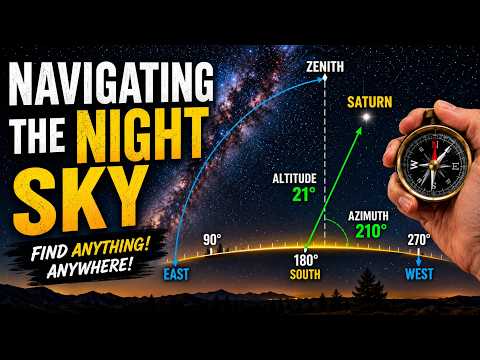
This video serves as an introduction to a comprehensive series initially developed for William Paterson University and CUNY Hunter, aimed at supporting online classes and course materials for introductory astronomy. By engaging with all the videos within this series, you will effectively complete a full undergraduate course in astronomy, equipping yourself with the knowledge and skills necessary to navigate the night sky with confidence. I invite you to join me on this enlightening journey through the cosmos. Together, we shall unravel the secrets of the universe, explore the beauty of the night sky, and ignite a lifelong passion for astronomy. Please ensure that you bring your telescope, a notebook, and an inquisitive mind as we embark on this astronomical adventure. • Amateur Astronomy Basics: Observational astronomy can be enjoyed without telescopes or cameras, simply by finding a dark location and observing the night sky. • Importance of Dark Skies: Dark skies are crucial for observing celestial objects like the Milky Way, which is often mistaken for smoke by city dwellers. • Finding the Milky Way: With a dark sky, the Milky Way becomes visible, offering a breathtaking view that contrasts with light-polluted cityscapes. • Star Identification: Identifying stars and constellations like Sagittarius, Scorpius, and Saturn in the night sky. • Light Pollution: The impact of urban light pollution on stargazing and the importance of finding dark locations. • Coordinate System: Using the horizontal or altitude-azimuth coordinate system to locate celestial objects like Saturn. • Azimuth Measurement: Measured clockwise from north towards east along the horizon to the point directly below the celestial object. • Altitude Measurement: Measured from the horizon upwards to the celestial object, with 90° being directly overhead (the zenith). • Horizontal Coordinate System: A system that uses azimuth and altitude to specify the position of celestial objects on the celestial sphere. • Local Observatory Coordinates: A coordinate system useful for determining the visibility of celestial objects based on the observer’s location and local obstructions. • Altitude and Atmospheric Effects: Objects low in the sky (small altitude) appear dimmer due to atmospheric interference, making higher altitudes preferable for observation. • Observing Run Planning: Astronomers generally aim to observe objects as high in the sky as possible to minimize atmospheric distortion and enhance visibility. • Stellarium Software Usage: Using Stellarium, a free sky simulation software, to demonstrate the concept of the horizontal coordinate system. • Star Observation and Tracking: Observing the azoth and altitude of various stars, particularly Beta Taurus, and how their positions change with time. • Location and Time Setting: The simulation is set in New York City during December 2034, with the time sped up to 10 minutes per second. • Star Location and Altitude: Elnath (Beta Tauri) is located at an altitude of about 48° and an azimuth of 90° (almost due east). • Impact of Observer’s Location: The altitude and azimuth of a star change depending on the observer’s location on Earth. • Example with Salt Lake City: In Salt Lake City, Utah, Elnath has an azimuth of 69° (north of east) and an altitude of 20°. • Star Position Changes: The position of a star in the sky changes depending on the observer’s location on Earth. • Observation of Beta Taurus: On December 6th, 2034, at 9:00 PM, Beta Taurus would be visible in the New York City sky. • Star Movement: Stars appear to move east to west across the sky due to Earth’s rotation. • Polaris and Latitude: The altitude of Polaris, the North Star, is a reliable measure of latitude on Earth. • Polaris at the North Pole: At the North Pole (90° north latitude), Polaris is located at the zenith, directly overhead. • Significance of Polaris: Polaris is important because it is located near the north celestial pole, the point in the sky around which all stars revolve. • Latitude Determination: Latitude can be determined by measuring the altitude of the celestial pole (North or South) above the horizon. • Southern Hemisphere Navigation: The South Celestial Pole lacks a bright star, making latitude determination challenging, but the Southern Cross asterism can be used as a guide. • Horizontal Coordinate System Limitations: The horizontal coordinate system, while useful for local observations, is not suitable for communicating celestial locations between observers separated by significant distances on Earth. #Astronomy #AmateurAstronomy #NightSky #ObservationalAstronomy #MilkyWay #Stellarium #Constellations #Sagittarius #CelestialObjects #AstronomyEducation #SpaceExploration #AstronomyLecture #BoulderColorado #AstronomyForBeginners #ExploreTheCosmos #CosmicJourney #DarkSky #Astrophotography #ScienceEducation #LearnAstronomy #StarGazing

Continue this lesson in the app
Install CourseHive on Android or iOS to keep learning while you move.