Summary
Keywords
Full Transcript
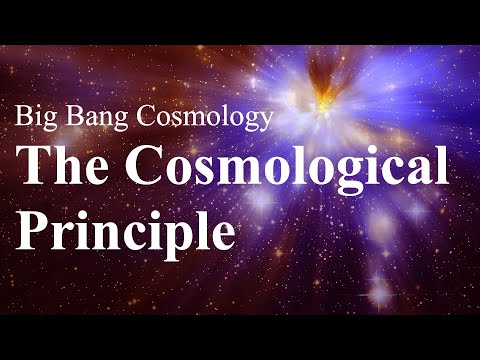
This video is part of a comprehensive series initially developed for William Paterson University and CUNY Hunter, aimed at supporting online classes and course materials for introductory astronomy. By engaging with all the videos within this series, you will effectively complete a full undergraduate course in astronomy, equipping yourself with the knowledge and skills necessary to navigate the night sky with confidence, learning all the basics and many advanced topics! Cosmology, a branch of astronomy, studies the universe’s origin, evolution, structure, and fate. It encompasses topics like galaxy distribution, cosmic expansion dynamics, and fundamental cosmic laws. Cosmology aims to determine the universe’s age, understand its initial conditions, and predict its future. Key assumptions include homogeneity (uniformity across large scales) and isotropy (uniformity in all directions). The cosmological principle asserts that no location is special, and physics is consistent everywhere. The Hubble Deep Field survey supports these assumptions by revealing a vast array of uniformly distributed galaxies. The APM Galaxy Survey further corroborates this uniform distribution across large spatial scales. Cosmology has evolved from the geocentric model to the heliocentric paradigm, with Kepler’s laws of planetary motion and Newton’s universal gravitation enhancing our understanding of celestial mechanics. Newton’s laws unified motion and gravity, suggesting universal physical principles apply throughout the universe. As observational capabilities improved, astronomers measured distances to galaxies billions of light-years away, supporting the uniformity and isotropy of the cosmos. In 1917, Albert Einstein proposed general relativity, suggesting spacetime’s dynamic expansion or contraction. To maintain a static universe, Einstein proposed the cosmological constant. However, observations by Vesto Slipher and Edwin Hubble confirmed galaxy recession, confirming the universe’s expansion and making the cosmological constant seemingly redundant. In contemporary cosmology, the cosmological constant has regained significance as a crucial component of understanding dark energy, associated with the accelerated expansion of the universe. This constant represents vacuum energy and explains cosmic acceleration. The universe displays remarkable uniformity, with consistent galaxy distributions and a lack of large-scale voids or clusters, reinforcing the cosmological principle and assumptions of homogeneity and isotropy, the foundation of modern cosmological models. This lecture has outlined the foundational concepts of cosmology: homogeneity, isotropy, and the cosmological principle. These principles are essential for understanding the universe’s large-scale structure and lay the groundwork for exploring the Big Bang theory and its evolution. Future discussions will delve deeper into these topics, examining the compelling evidence supporting the Big Bang theory and illuminating the fundamental nature of the universe and its vast expanse. #Cosmology #BigBang #Universe #Homogeneity #Isotropy #Galaxies #Space #Astronomy #CosmicPrinciples #ScienceExplained #DarkEnergy #GeneralRelativity #CosmicExpansion #Astrophysics #CelestialMechanics

Continue this lesson in the app
Install CourseHive on Android or iOS to keep learning while you move.