Summary
Keywords
Full Transcript
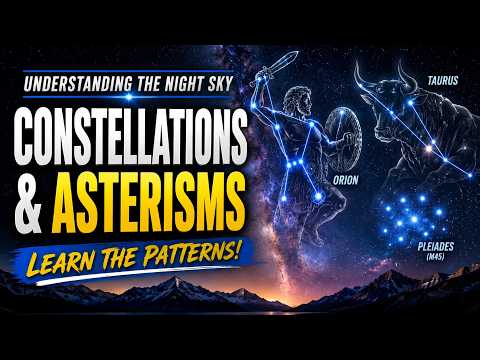
This video is part of a comprehensive series initially developed for William Paterson University and CUNY Hunter, aimed at supporting online classes and course materials for introductory astronomy. By engaging with all the videos within this series, you will effectively complete a full undergraduate course in astronomy, equipping yourself with the knowledge and skills necessary to navigate the night sky with confidence, learning all the basics and many advanced topics! • Constellation Definition: A pattern of stars in the sky, not necessarily related to each other. • Asterism Definition: A recognizable pattern of stars, which can be part of a constellation or span across multiple constellations. • Orion Identification: Identifiable by its belt (three stars in a diagonal line), shoulders, feet, and sword. • Constellation and Asterism Definition: Both are named patterns of stars in the sky, not necessarily related, and their appearance depends on the observer’s location in space. • Orion Constellation Mythology: In Western mythology, Orion was a hunter killed by a scorpion, and both were placed in the sky as constellations by Zeus. • Cultural Interpretations of Orion: Different cultures have their own interpretations of Orion, such as a shepherd, a god, or a hunter. • Origin of Star Names: Current star names of Orion originate from medieval Muslim astronomy. • Human Connection to the Stars: Humanity’s need to connect with the everlasting and unchanging is reflected in the stories and myths associated with star patterns. • Impact of Light Pollution: Losing dark skies to light pollution diminishes our sense of connection to something larger than ourselves. • Star Name Origin: Many star names have Arabic origins, reflecting the significant contributions of Muslim astronomers in preserving and advancing astronomical knowledge. • Al-Dearon’s Name Origin: Al-Dearon, meaning “the follower” in Arabic, was named so because it appears to follow the Pleiades star cluster. • Sirius’s Name Origin: Sirius’s name, meaning “the scorcher” in ancient Greek, reflects its association with hot weather. • Orion Constellation Identification: Description of how to locate Orion in the night sky using stars like Betelgeuse, Bellatrix, and Rigel. • Orion’s Sword and Nebula: Explanation of the fuzzy star in Orion’s sword, which is actually the Great Nebula in Orion (M42). • Standardization of Constellations: Brief history of how the 88 modern constellations with clear boundaries were established by Henry Norris Russell and Eugène Delporte. • Constellation Boundaries: The boundaries of constellations are defined by red lines, encompassing all celestial objects within those areas. • Star Chart Features: Official star charts, like the one from Sky and Telescope, depict constellations with boundaries, star magnitudes, proper names, Bayer designations, and asterisms. • Star Magnitude: A star’s magnitude measures its brightness, with lower magnitudes indicating brighter stars. The faintest stars visible to the naked eye are around magnitude six. • Star Chart Usage: Star Charts are used to locate celestial objects and are also used by professional astronomers. • Constellation Example: Ursa Major (Big Dipper) and Ursa Minor (Little Dipper) are used as an example to illustrate the relationship between constellations and stars. • Ursa Major Description: Ursa Major is the name of the constellation, the Big Dipper is its familiar asterism, and the rest of the constellation is highlighted with bolder green lines. • Ursa Major Constellation Objects: M101, M81, M82, and M97 are major objects in Ursa Major visible with a small telescope. • Star Chart Resources: NASA’s Jet Propulsion Laboratory and the Astronomical League provide free monthly star charts for stargazing. • Naked Eye Observing Tips: Start by observing the night sky with the naked eye, using a star chart to identify constellations and celestial objects. • Negative Effects of Phone Usage: Using the phone at night can cause night blindness and hinder stargazing. • Content of the Discussion: The discussion covered constellations and asterisms. #Constellations #Asterisms #NightSkyExploration #OrionsBelt #Stellarium #CelestialNavigation #AstronomyEducation #MythologyInAstronomy #StarIdentification #AstroCommunity #ExploreTheUniverse

Continue this lesson in the app
Install CourseHive on Android or iOS to keep learning while you move.