Summary
Keywords
Full Transcript
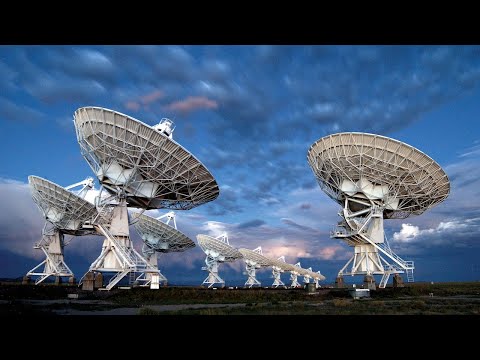
Herein, we learn about radio telescopes, what they do, what their function is, and some of the major radio facilities around the world. We also examine angular resolution and the need for interferometry in radio telescopes. This is part of my intro Astronomy class taught at Willam Paterson University and CUNY Hunter. https://science.nrao.edu National Radio Astronomy Observatory (NRAO) http://greenbankobservatory.org Green Bank Observatory http://outreach.naic.edu/ao/content/arecibo-observatory-2 Arecibo Observatory https://en.wikipedia.org/wiki/Five-hundred-meter_Aperture_Spherical_Telescope Five-hundred-meter Aperture Spherical radio Telescope (FAST) https://svs.gsfc.nasa.gov/10770 Centaurus A recent news http://www.vla.nrao.edu NRAO Very Large Array http://www.qsl.net/n1irz/contact.html Filming 'Contact' at the VLA https://en.wikipedia.org/wiki/Astronomical_interferometer Radio Interferometry https://science.nrao.edu/facilities/vlba NRAO Very Long Baseline Array (VLBA) https://eventhorizontelescope.org Event Horizon Telescope https://apod.nasa.gov/apod/ap040616.html M87 using the Canada-France-Hawaii Telescope http://hubblesite.org/image/968/news_release/2000-20 Black Hole-Powered Jet of Electrons and Sub-Atomic Particles Streams From Center of Galaxy M87 https://www.nrao.edu/pr/1999/m87big/ NRAO M87 with its jet

Continue this lesson in the app
Install CourseHive on Android or iOS to keep learning while you move.