
Summary
Keywords
Full Transcript
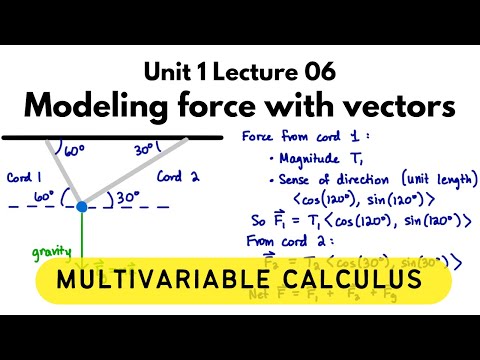
(Unit 1 Lecture 06) This is our first look at modeling a force acting on an object with vectors. In the case of multiple forces, the "net force" is the vector sum. Key Points: 1. Vector Representation of Forces: - Forces are represented as vectors, with magnitude and direction. - The net force on an object is the vector sum of all individual forces acting on it. 2. Gravity and Horizontal Force Example: - An object's weight due to gravity is calculated as mass⋅acceleration due to gravity. - The net force on an object under gravity and a horizontal force is the sum of the gravitational force vector and the horizontal force vector. 3. Suspended Object Example: - For an object suspended by cords, the forces exerted by the cords are determined using trigonometric functions to decompose the forces into x and y components. - The equilibrium condition (net force equals zero) is used to set up a system of equations to solve for the unknown forces. 4. Trigonometry in Force Decomposition: - Trigonometric functions (sine and cosine) are used to find the components of the forces along the cords based on the angles they make with the ceiling. #mathematics #math #multivariablecalculus #vectorcalculus #iitjammathematics #calculus3

Continue this lesson in the app
Install CourseHive on Android or iOS to keep learning while you move.

