
Summary
Keywords
Full Transcript
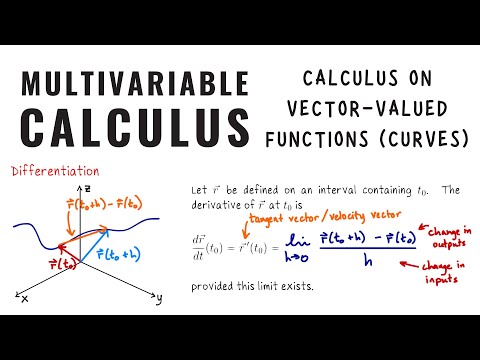
A discussion of limits, continuity, differentiation, and integration of vector-valued functions r(t)=(P(t),Q(t),R(t)). The main conclusion is that we perform operations component-by-component. Around 5:45, I meant "as t approaches 3" not "as r approaches 3". (Unit 2 Lecture 2) Key Points: 1. Limits of Vector-Valued Functions: - Definition: The limit of a vector-valued function 𝐫(𝑡)=⟨𝑃(𝑡),𝑄(𝑡),𝑅(𝑡)⟩ as 𝑡 approaches 𝑡0 is the vector of the limits of its component functions. - Existence: A limit exists if and only if each component limit exists. 2. Continuity of Vector-Valued Functions: - A function is continuous at 𝑡0 if it is defined at 𝑡0 and the limit of 𝐫(𝑡) as 𝑡 approaches 𝑡0 equals 𝐫(𝑡0). - This is determined by the continuity of each component function at 𝑡0. 3. Differentiation of Vector-Valued Functions: - The derivative 𝐫′(𝑡0) is the vector of the derivatives of the component functions at 𝑡0. - Properties: We look at properties like the derivative of a constant vector, scalar multiplication, sum/difference, product rules, and chain rule. 4. Integration of Vector-Valued Functions: - To integrate a vector-valued function over an interval, each component function is integrated over that interval. - The antiderivative is defined similarly to single-variable calculus. 5. Smooth Curves: - A curve is smooth if it has a differentiable parameterization with a non-zero tangent vector. #calculus #multivariablecalculus #mathematics #iitjammathematics #calculus3 #vectorcalculus #mathtutorial

Continue this lesson in the app
Install CourseHive on Android or iOS to keep learning while you move.

