
Summary
Keywords
Full Transcript
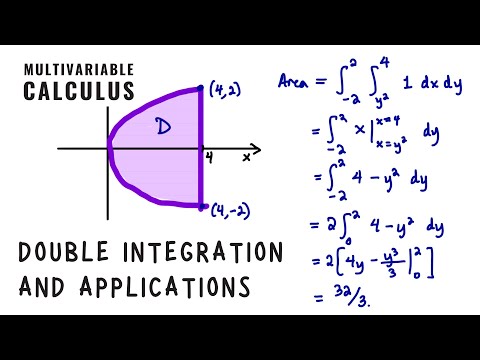
We look at three applications for integrating functions of the form z=f(x,y) over regions in the (x,y)-plane: (1) area computations, (2) average value computations, and (3) center of mass computations. Multivariable Calculus Unit 4 Lecture 4 We start by illustrating area computations using double integrals. Recall from single variable calculus that integrating 𝑓(𝑥) = 1 over [𝑎,𝑏] can be thought of as computing the width of the interval [𝑎,𝑏], as the result is b-a. Extending this idea to double integrals, integrating 𝑓(𝑥,𝑦) = 1 over a rectangle defined by 𝑎 ≤ 𝑥 ≤ 𝑏 and 𝑐 ≤ 𝑦 ≤ 𝑑 gives the area of the rectangle: (𝑑−𝑐)(𝑏−𝑎). We can build off of this to compute the areas of more complex shapes, like triangles and closed discs. For a triangle, integrating 1 over the triangular region yields its area. For a closed disc of radius 𝑅, the integral setup is more suitable for polar coordinates and will be covered in a different lesson (in Unit 5). However, conceptually the result of such an integration would be 𝜋𝑅^2, the area of the circle. The concept of average value that you may have seen for 𝑦=𝑓(𝑥) in single variable calculus, 𝑓_{ave} = 1/(𝑏−𝑎)⋅ ∫_𝑏^𝑎 𝑓(𝑥) 𝑑𝑥 can be extended to functions 𝑧=𝑓(𝑥,𝑦) over two dimensional domains. The average value of a function over a domain 𝐷 in the 𝑥𝑦-plane is the integral of the function over the domain divided by the area of the domain. Using our knowledge of areas that we just learned, this is 𝑓_{ave} = ∬_𝐷 𝑓(𝑥,𝑦) 𝑑𝐴 ⋅ Area of 𝐷 = ∬_𝐷𝑓(𝑥,𝑦)𝑑𝑥 /∬_𝐷 1 𝑑𝐴. Sometimes 𝐷 will be a random Type 1 or 2 region and you may need to compute that denominator, but other times you may recognize 𝐷 as a famous geometrical shape whose area you already know. In that case, no need to compute it explicitly! This average value represents a height, which, when multiplied by the domain's area, equals the integral of the function The center of mass for a plane lamina, particularly when the lamina has non-uniform density, is a key concept in physics. The center of mass is the point where the lamina can be perfectly balanced (although it doesn't actually have to be part of the lamina--e.g. if the lamina was annular/donut shaped). To find this point, we first need to calculate the lamina's mass and moments about the 𝑥 and 𝑦 axes. The mass (𝑀) of the lamina is calculated as the integral of the density function (𝜎(𝑥,𝑦)) over the domain 𝐷. This requires setting up and solving a double integral. Moments 𝑀𝑥 and 𝑀𝑦 are computed similarly, but with an additional factor of 𝑥 (for 𝑀𝑦) and 𝑦 (for 𝑀𝑥) within the integral, accounting for the displacement of each mass element from the respective axis: The coordinates of the center of mass are given by X = 𝑀𝑦/𝑀 and Y = 𝑀𝑥/𝑀. This computation effectively finds the average x and y coordinates of the mass distribution. If you finish out the example from the lecture, you should find that the center of mass coordinates are (279/85 , 117/85). #calculus3 #doubleintegrals #integralcalculus #multivariablecalculus #averagevalue #centerofmass #iitjammathematics #mathematics #mathtutorial

Continue this lesson in the app
Install CourseHive on Android or iOS to keep learning while you move.




