
Summary
Keywords
Full Transcript
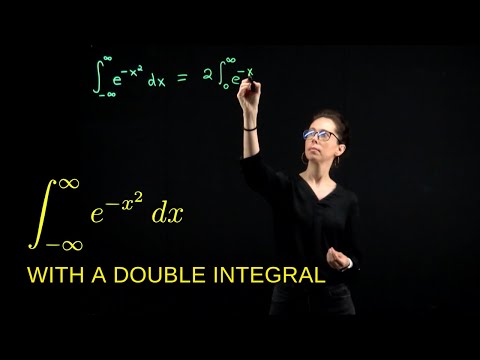
In this video, I demonstrate how to compute the integral of e^(-x^2) from negative infinity to infinity, a famous and elegant example in calculus. Since e^(-x^2) does not have an elementary antiderivative, we use a technique that involves squaring the integral and converting it into a double integral. By switching to polar coordinates, we simplify the expression and compute the integral over a quarter disk in the first quadrant. By evaluating this double integral in polar coordinates, we show that the original integral is equal to the square root of pi. #Mathematics #Calculus #Integrals #MathTutorial #MultivariableCalculus #MathEducation #MathTechniques #PolarCoordinates #AdvancedCalculus #calculus3 #iitjam

Continue this lesson in the app
Install CourseHive on Android or iOS to keep learning while you move.




