
Summary
Keywords
Full Transcript
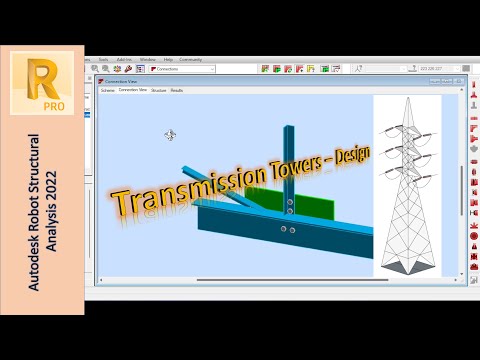
WARNING!!! The wind load on the structure was omitted, as explained in a previous video. You have to add it to your model. Welcome to Part 5 of our series on modeling lattice steel transmission towers using Autodesk Robot! In this video, we'll be finalizing the modeling process and sharing our insights on the design of these structures. Our team has spent countless hours analyzing and testing different designs, and we're excited to share our findings with you. Whether you're an engineer, architect, or simply interested in the design process, we hope you'll find our insights valuable. In this video, we'll be using Autodesk Robot to complete the final steps in modeling lattice steel transmission towers. We'll cover topics such as load analysis, structural integrity, and design optimization. So sit back, relax, and join us as we wrap up our series on modeling lattice steel transmission towers using Autodesk Robot. Timestamps: 0:00 Introduction 0:35 Forgotten Release 2:48 Member Design Grouping 5:48 Design of Members and Commentary 10:10 Reporting 13:24 Connection Design 15:44 Robot Limitations 17:41 Practical Hint 21:43 Calculation 23:55 Outro Current Video Ideas for the Future: - More details about modal participation / report? - Masses and stiffnesses to control modes - LL Reduction in ACI/ASCE (vertical and horizontal) - A possible way to model columns with pressure areas - Deeper dive into slab reinforcement. - Raft with larger thickness and positions - Robot - seemingly - erratic deformation when supported by beams and columns - A way to manually “clean-up” simple mesh like the above - Wood and Armer Moments in Slabs and their meaning - Complex and Principle results - Simple TBM tunnel lining analysis in robot

Continue this lesson in the app
Install CourseHive on Android or iOS to keep learning while you move.




