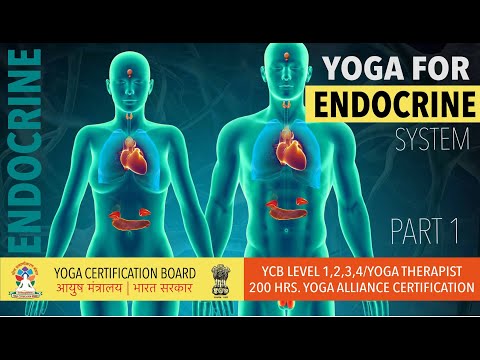
|| ONLINE YOGA ANATOMY COURSE BY RITESH || Anatomy Simplified || For Yoga Teachers | 1 Month Intense Course | Pilates Certification Yoga for the Endocrine System | The Endocrine System | Asana Sequence | Part 1 | YCB & Yoga Allianc
Yoga for the Endocrine System | The Endocrine System | Asana Sequence | Part 1 | YCB & Yoga Allianc Transcript and Lesson Notes
Did you know there is a system in your body that acts just like the teacher in your classroom? Your endocrine system is your body's teacher. It gives organs and other parts of your body instructions so they know what to do. Just like your teacher controls activities in your classroom, your endocrine system controls
Quick Summary
Did you know there is a system in your body that acts just like the teacher in your classroom? Your endocrine system is your body's teacher. It gives organs and other parts of your body instructions so they know what to do. Just like your teacher controls activities in your classroom, your endocrine system controls
Key Takeaways
- Review the core idea: Did you know there is a system in your body that acts just like the teacher in your classroom? Your endocrine system is your body's teacher. It gives organs and other parts
- Understand how Endocrine System fits into Yoga for the Endocrine System | The Endocrine System | Asana Sequence | Part 1 | YCB & Yoga Allianc.
- Understand how Yoga for Endocrine System fits into Yoga for the Endocrine System | The Endocrine System | Asana Sequence | Part 1 | YCB & Yoga Allianc.
- Understand how Pitutiary Glands fits into Yoga for the Endocrine System | The Endocrine System | Asana Sequence | Part 1 | YCB & Yoga Allianc.
- Understand how Yoga Certification Board fits into Yoga for the Endocrine System | The Endocrine System | Asana Sequence | Part 1 | YCB & Yoga Allianc.
Key Concepts
Full Transcript
Did you know there is a system in your body that acts just like the teacher in your classroom? Your endocrine system is your body's teacher. It gives organs and other parts of your body instructions so they know what to do. Just like your teacher controls activities in your classroom, your endocrine system controls many activities inside your body like how to quickly grow and how your body uses food.
In this video, we will discuss about the endocrine system. It's various glands and how yoga therapy can help to regulate these glands properly by means of asanas and pranayam. The endocrine system acts like a king who guides the other cells in the body. You might say endocrine glands are a little like bossy.
They tell your cells what to do but that's actually a good thing. Without your endocrine glands and the hormones, they release your cells wouldn't know when to do important things. For instance, your bones wouldn't get the message that it's time for you to grow and get bigger and your body wouldn't know that it's time to begin puberty. The body changes that turn kids into grownups.
You have a variety of endocrine glands in different sizes and shapes located in different parts of the body. In the human body, a group of organs called glands make up the endocrine system. Glans make hormones. These are chemicals that help control activities of the body.
In sets, fish, amphibians, reptiles, birds and mammals all have endocrine system. Now let's talk about the glands. What are these glands? So the glands of human endocrine system make more than 20 major hormones.
The hormones travel in the blood to cells throughout the body. A part of the brain called hypothalamus helps to control the release of many hormones. Let's talk about what is hypothalamus. The hypothalamus is in the lower central part of the brain.
It links the endocrine system and nervous system. Nerv cells in the hypothalamus make chemicals that control release of hormones secreted from the pituary glands. The hypothalamus gathers information sensed by the brain, such as the surrounding temperature, light exposure and feelings and sends it to the pituary gland. This information influences the hormones that the pituary makes and release.
The major glands of the endocrine system includes the pituary thyroid and the adrenal glands as well as the pancreas. The ovaries are glands found only in women. Men have glands called testers. So let us try to understand what is the pituary gland and its location and how yoga can help to regulate the pituary gland.
The pituary gland is a bean-sized gland at the base of the brain. It sits beneath the hypothalamus. The pituary gland makes hormones that control many body functions. One hormone controls the growth of the body.
Another helps women deliver babies and help produce milk so that women can nurse their babies. Other hormones made by the pituary gland control how other endocrine glands work. The pituary gland controls all the other endocrine glands in your body, including thyroid, parathyroid, pancreas and reproductive and adrenal glands. The pituary gland regulates hormones that have to do with growth, digestion, protein, absorption and blood pressure.
In yoga, the third eye chakra governs the pituary gland located in the middle of your brows. The third eye deals with intuition and teachings. It's your internal compass. Try yoga asanas for the pituary glands, breathwork and mantras that stimulate the third eye.
Try yoga for pituary gland disorders. Try yoga poses that stimulate the pituary, usually place your head below your heart and are for advanced practitioners. Pinchamayurasana or Phoraam balance has your turned upside down balance on your Phoraam with your legs up in the air. Handstand is your standard mountain pose turned upside down and Kapotasana or King Pijan has a bent backwards in an arc, supported just by your shins and Phoraam.
Wheel upward boopos and supported headstands are two additional inversions that are more intermediate in nature and stimulate the pituary. If you're not quite up for these posture, stimulate your third eye with general options. Wheel pose with your forehead resting in the mat or supported on a block is an option dolphin pose in which you are in a downward dog-like position supported on your Phoraam. Also stimulates the pituary and third eye when you direct your gaze towards the floor.
Simple tapping exercises also brings attention, awareness and energy to the pituary. Stand in a simple seat and tapping the area between the bros gently with the pads of your fingers creates an awakening vibration. Pranayam for the pituary gland include some pranayam for your pituary glands in your yoga practice. Breathwork helps bring attention to your third eye, particularly the pranayam known as Brahmari or Be Breath.
According to a small study published by International Journal of Yoga in the May Aga's issue, the practice of Brahmari pranayam, that is humming Be Breath, was also shown to decrease blood pressure. If you can't quite arrange your hands, the right way don't give up. Simply exhale the oam sound and make the buzz of mmmmmmmmmmmmmmmmmmmmmmmmm. This will still bring attention to your third eye, stimulate your pituary and create a sense of calmness.
Allow the exhale breath to last as long as possible without straining. Let's talk about the thyroid and paratheirate glands. The thyroid gland is located at the base of the neck. It produces a hormone, a hormone that controls how fast, cell burn, food to release energy.
Four paratheir glands are attached to the thyroid glands. They make a hormone that helps control the amount of calcium in the blood. Now calcium is an important mineral that helps bone to grow. These show that almost every third Indian suffers from some kind of thyroid disorders.
Now thyroid problems are one of the main reasons for weight gain and hormonal imbalances. This condition is a more common in women than in men. A thyroid disorders can range from bending in goiters that is enlarged glands that needs no treatment to life threatening cancer. A healthy lifestyle which includes good nutrition, regular exercise can help you live well with a thyroid disease.
In fact adding yoga to your daily routine may help improve your thyroid function and benefit overall health. There are mainly two types of thyroid disorders. Hypo thyroidism that means not having sufficient thyroid hormones and hyper thyroid have excessive thyroid hormones. One of the main cause is due to the stress in our daily lives.
The thyroid glands produces hormones that influence almost all of the metabolic processes in your body. Now let us talk about yoga for thyroid. Yoga brings many benefits to your overall health and well-being. It can balance your energy, increase flexibility and relieve stress.
There is a connection between stress and hypothyroidism. But certain yoga poses are thought to balance out thyroid that are either underactive or overactive. Yoga studies have shown the positive effect of yoga on improving thyroid function. Keep in mind that these poses cannot cure your thyroid imbalance.
Yoga is considered a complimentary therapy. It shouldn't be used as a replacement for any therapies or medications. You are currently undergoing. Below I have mentioned some yoga poses that are considered as throat stimulating.
They are thought to improve circulation and energy flow around the thyroid and stretch and strengthen the neck. Be sure to honor the limitations of your body. Be gentle and easy with yourself. You can adjust or modify the poses to suit your needs.
You don't have to do all of the poses in one session. You can try a pose or two throughout the day. One is a supported shoulder stand. The shoulder stand is often the first pose that is suggested to treat the thyroid.
Since it is an inversion, it stimulates blood flow to the glands in the upper body. This is believed to have a positive effect on the efficiency of the thyroid. Additionally, the way your chin is tucked in your chest in this position is believed to benefit thyroid functions. So pose that is halasun.
In flow pose, your thyroid is believed to get the same stimulation as it does in shoulder stand. You may find it easier to plow pose that is your halasun. Now let's look about the fish pose. Fish pose is the perfect counter pose to shoulder stand.
It's more accessible and can also be done on its own. Fish pose and shoulder stand are thought to be most effective for improving thyroid function. As you let your head hang back in fish pose, you stimulate your thyroid by exposing the throat area. Legs up the wall pose.
That is, we pre-thinner or legs up the wall pose is a restorative inversion. It doesn't put pressure on the neck and is suitable for most people. It's an excellent choice since it's passive and helps to restore your balance. This pose is thought to relieve stress that can contribute to thyroid imbalance.
Camel pose, the strong neck extension in camel pose is set to stimulate the thyroid glands and increase circulation to this area. The takeaway, adding some or all of these yoga poses to your routine may help to improve your thyroid function. Do what feels best on a daily basis. Try to do at least a little bit of yoga each day.
These poses may lead you to discover new variations and postures that bring you the most benefit. Always listen to your body. Be aware of how each pose affects you and especially your thyroid. So friends, in this video, we covered the hypothalamus, the pituitary gland and the thyroid glands.
In the next part, we will discuss about the adrenal pancreas, ovaries and testers. Till then, take care, keep smiling. Namaste.
Lesson FAQs
What is Yoga for the Endocrine System | The Endocrine System | Asana Sequence | Part 1 | YCB & Yoga Allianc about?
Did you know there is a system in your body that acts just like the teacher in your classroom? Your endocrine system is your body's teacher. It gives organs and other parts of your body instructions so they know what to do. Just like your
What key concepts are covered in this lesson?
The lesson covers Endocrine System, Yoga for Endocrine System, Pitutiary Glands, Yoga Certification Board, YCB.
What should I learn before Yoga for the Endocrine System | The Endocrine System | Asana Sequence | Part 1 | YCB & Yoga Allianc?
Review the previous lessons in || ONLINE YOGA ANATOMY COURSE BY RITESH || Anatomy Simplified || For Yoga Teachers | 1 Month Intense Course | Pilates Certification, then use the transcript and key concepts on this page to fill any gaps.
How can I practice after this lesson?
Practice by applying the main concepts: Endocrine System, Yoga for Endocrine System, Pitutiary Glands, Yoga Certification Board.
Does this lesson include a transcript?
Yes. The full transcript is visible on this page in indexable HTML sections.
Is this lesson free?
Yes. CourseHive lessons and courses are available to learn online for free.
Continue Learning

Continue this lesson in the app
Install CourseHive on Android or iOS to keep learning while you move.