Summary
Keywords
Full Transcript
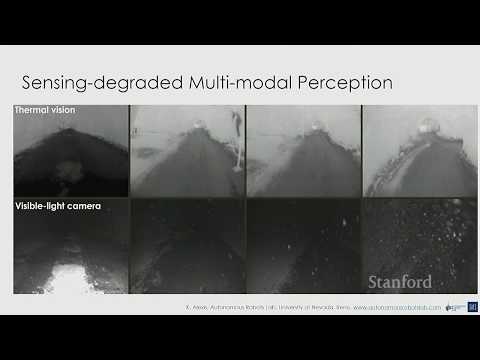
Kostas Alexis University of Nevada, Reno October 18, 2019 This talk will present our contributions in the domain of field-hardened resilient robotic autonomy and specifically on multi-modal sensing-degraded GPS-denied localization and mapping, informative path planning, and robust control to facilitate reliable access, exploration, mapping and search of challenging environments such as subterranean settings. The presented work will, among others, emphasize on fundamental developments taking place in the framework of the DARPA Subterranean Challenge and the research of the CERBERUS (https://www.subt-cerberus.org/) team, alongside work on nuclear site characterization and infrastructure inspection. Relevant field results from both active and abandoned underground mines as well as tunnels in the U.S. and in Switzerland will be presented. In addition, a selected set of prior works on long-term autonomy, including the world-record on unmanned aircraft endurance will be briefly overviewed. The talk will conclude with directions for future research to enable advanced autonomy and resilience, alongside the necessary connection to education and the potential for major broader impacts to the benefit of our economy and society. View the full playlist: https://www.youtube.com/playlist?list=PLoROMvodv4rMeercb-kvGLUrOq4HR6BZD Learn more about our Robotics and Autonomous Systems Graduate Program: https://online.stanford.edu/programs/robotics-and-autonomous-systems-graduate-program 0:00 Introduction 0:34 Resilient Autonomy: A Goal for Robotics 1:29 A Vision for Robotics Research 3:18 Resilient Autonomy in High-Risk Environments 7:50 Sensing-degraded Multi-modal Perception 13:57 Informative Path-Planning in High-Risk Settings 29:27 Last Resort Resilience via Controlled Interaction 32:03 Reconfigurable Systems of Systems 38:33 Funding Support 42:08 Selected Previous Results: Physical Interaction 43:06 Open Source Contributions 43:51 Application Domains

Continue this lesson in the app
Install CourseHive on Android or iOS to keep learning while you move.