
Summary
Keywords
Full Transcript
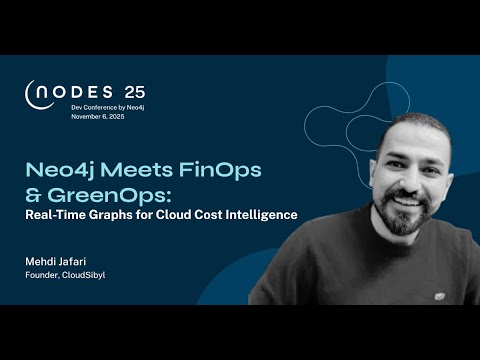
In traditional FinOps and GreenOps implementations, teams often rely on complex spreadsheets or relational tables to track cloud costs, resource usage, and environmental impact. Although these approaches may work initially, they quickly become brittle, opaque, and difficult to scale—especially when dealing with dynamic, interconnected systems across multicloud environments. In this session, Mehdi Jafari will share how his team replaced fragmented tabular reporting with a real-time graph-based architecture using Neo4j to power FinOps (Financial + Environmental Operations) insights. He will walk you through the challenges of working with traditional data models, the turning point that led to adopting Neo4j, and how modeling relationships between services, teams, and emissions unlocked deeper insights and automation. You will learn how to structure and query operational data as a graph; integrate Neo4j into a real-time pipeline; and apply this approach to gain visibility, accountability, and efficiency in your cloud strategy. Whether you're building internal tools or scalable FinOps platforms, this session will offer a practical blueprint for evolving beyond tables into connected intelligence. Speaker: Mehdi Jafari Resources: Get Started with Aura - https://bit.ly/3LOLrjh Deployment Center - https://bit.ly/4jOelM3 Ground AI Systems and Agents with Neo4j - https://bit.ly/4oVsnyb #nodes2025 #neo4j #graphdatabase #graphrag #knowledgegraph

Continue this lesson in the app
Install CourseHive on Android or iOS to keep learning while you move.


