Summary
Keywords
Full Transcript
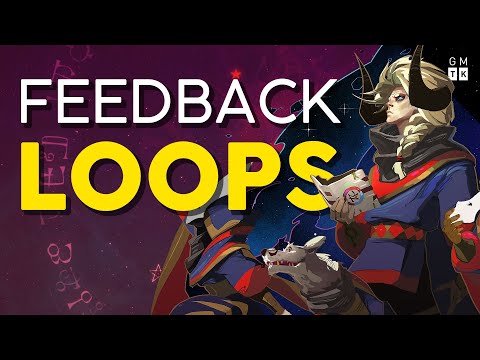
🔴 Get bonus content by supporting Game Maker’s Toolkit - https://gamemakerstoolkit.com/support/ 🔴 Playing Pyre over Christmas got me thinking about feedback loops: the reward structures in games that can reinforce or balance out winners and losers. In this episode I’ll explain what this all means, and talk about the design of Pyre’s positive and negative loops. === Sources and Resources === - Sources Solving XCOM’s Snowball Problem | Pentadact http://www.pentadact.com/2016-02-25-solving-xcoms-snowball-problem/ Git along there, little doggies | Team Fortress 2 http://www.teamfortress.com/post.php?id=1872 - Additional resources Level 4.4: Feedback Loops | Canvas https://learn.canvas.net/courses/3/pages/level-4-dot-4-feedback-loops Designer's Notebook: Positive Feedback | Gamasutra https://www.gamasutra.com/view/feature/131426/designers_notebook_positive_.php [PPT] Feedback Systems and the Dramatic Structure of Competition | Mark LeBlanc http://algorithmancy.8kindsoffun.com/cgdc99.ppt === Chapters === 00:00 - Intro 00:35 - What is a feedback loop? 00:58 - Positive Feedback Loops 01:55 - Negative Feedback Loops 02:43 - Benefits of feedback loops 03:47 - Disadvantages of feedback loops 06:13 - How Pyre fixes feedback loops 08:16 - How loops balance themselves out 10:55 - Dampening feedback loops 12:50 - Patreon Credits === Games Shown === Bastion (Supergiant Games, 2011) Transistor (Supergiant Games, 2014) Pyre (Supergiant Games, 2017) Call of Duty: Infinite Warfare (Infinity Ward, 2016) Call of Duty 4: Modern Warfare (Infinity Ward, 2007) Chess Ultra (Ripstone Ltd., 2017) Mario Kart 8 Deluxe (Nintendo, 2017) Tekken 7 (Bandai Namco, 2017) Splatoon (Nintendo, 2015) Forza Horizon 3 (Playground Games, 2016) Titanfall 2 (Respawn Entertainment, 2016) Team Fortress 2 (Valve Corporation, 2007) Arms (Nintendo, 2017) XCOM 2 (Firaxis, 2016) Battlefield 4 (EA DICE, 2013) SteamWorld Dig 2 (Image and Form, 2017) Final Fantasy XV (Square Enix, 2016) The Witcher 3: Wild Hunt (CD Projekt, 2015) Resident Evil 4 (Capcom Production Studio 4, 2005) NBA 2K18 (Visual Concepts, 2017) Civilization V (Firaxis Games, 2010) Dark Souls (From Software, 2011) Call of Duty: Modern Warfare 2 (Infinity Ward, 2009) Call of Duty: Black Ops (Treyarch, 2010) Devil May Cry (Capcom, 2001) Donkey Kong Country: Tropical Freeze (Retro Studios, 2014) === Credits === Music used in this episode Pyre soundtrack k. Part 2 - 01 untitled 1, animeistrash Other credits MW2 - 6 KILLS WITH ONE PREDATOR MISSILE | Volound https://www.youtube.com/watch?v=zPjlZTqdFh8 TACTICAL NUKE with AKIMBO Model 1887 - Modern Warfare 2 | TheKoreanSavage https://www.youtube.com/watch?v=lFexH5_lwg8 === Subtitles === Contribute translated subtitles - https://amara.org/v/C3BEl/

Continue this lesson in the app
Install CourseHive on Android or iOS to keep learning while you move.