Summary
Keywords
Full Transcript
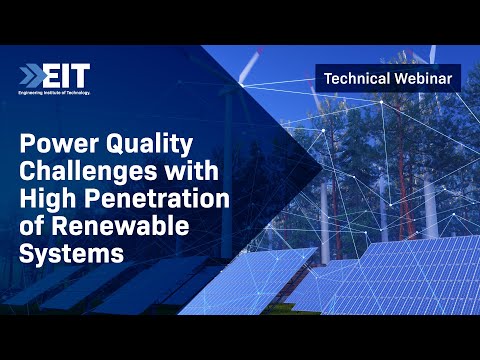
Photovoltaic systems represent a significant source of power generation, with their production susceptible to fluctuations caused by changing shading conditions resulting from varying weather and environmental factors. While the modular multilevel converter (MMLC) stands out as a promising choice for achieving high power, the conventional MMLC, in its quest for more voltage levels, demands additional cells. This, in turn, amplifies complexity and results in increased losses. In this webinar, we propose the implementation of a hybrid MMLC, which employs fewer IGBT switches for the same number of output levels, ultimately reducing losses and enhancing voltage output. The augmentation of power production is realized through the series and parallel connection of half and full bridge cells in the converter configuration. Furthermore, the converter adeptly addresses power quality issues, including voltage, current, and power, without the need for active or passive filters. Despite these advancements, fluctuations in input irradiation and temperature introduce disturbances to output parameters such as voltage, current, and power. Mitigating these imbalances in a grid-connected converter is crucial for stabilizing control and ensuring the quality of power injected into the grid. As a solution, the implementation of zero sequence control (ZSC) is proposed to generate balanced power, especially when dealing with unstable input parameters. To achieve power balance among the converter phases being supplied to the grid, zero sequence voltage (ZSV) is injected into each phase of the converter output. This validation process ensures the equilibrium of power among the phases fed into the low voltage grid. Simulation results are presented to assess the output parameters both before and after the injection of ZSV in the low voltage (LV) grid-connected Hybrid MMLC of a large-scale PV system. These results demonstrate the improved performance achieved through this approach. Key takeaways from this webinar: - Modelling and implementation of an efficient MMLC converter with hybrid approach for full and half bridge cells arranged in series and parallel for better output performance. - ZSC is used for solving power quality issues that arise during different shading patterns within phases of the converter. - The proposed controller scheme satisfactorily handles the variable irradiance values with the MPPT application. Presenter: Dr. Munira Batool, EIT Lecturer and Postgraduate Supervisor Dr. Munira Batool is an Online Lecturer, Unit Coordinator and Postgraduate Research Supervisor in Electrical Engineering Department. She graduated with a PhD degree from Curtin University in May 2019. She has over 13 years of extensive experience of teaching and research in the university sector. She is currently working as Assistant Professor in University of Engineering and Technology, Taxila Pakistan. She has commendable teaching experiences in Power System Generation, Power System Transmission, Power System Distribution and Utilization, Power System Protection and Electric Power System Analysis. Her research interests include Distributed Energy Generation based Power systems, renewable energy sources integration and control, microgrids and smart grid. Initially, this was applied to improve the performance of Distributed Energy Generation systems using optimization methods. More recently, her research efforts have involved the optimal sizing and siting of renewable energy sources (like PV and Wind etc.) in distribution networks using novel Power Electronic converters and controllers. She is a subject matter expertise on modelling and simulating renewable energy based power system networks using software commonly used in the industry. The results of her research have been published in high ranked journal and conference papers. __ The Engineering Institute of Technology (EIT) is one of the only institutes in the world specializing in Engineering. We deliver industry-focused professional certificates, diplomas, advanced diplomas, undergraduate and graduate certificates, bachelor’s and master’s degrees, and a Doctor of Engineering to students from over 140 countries. -- FOLLOW US! Website: www.eit.edu.au Instagram: www.instagram.com/eit_engineering_training Facebook: www.facebook.com/EngineeringInstituteofTechnology LinkedIn: www.linkedin.com/school/engineering-institute-of-technology Twitter: https://twitter.com/enginstoftech -- All content in this video is current as of the date of upload. -- EIT CRICOS Provider Number: 03567C | EIT Institute of Higher Education: PRV14008 | EIT RTO Provider Number: 51971 -- #eit #engineeringinstituteoftechnology #engineering #engineeringstudent #studyengineering #renewableenergy #electricalengineering #photovoltaic

Continue this lesson in the app
Install CourseHive on Android or iOS to keep learning while you move.