Summary
Keywords
Full Transcript
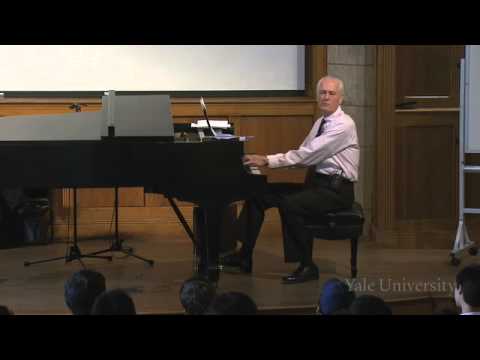
Listening to Music (MUSI 112) Professor Wright explains the way harmony works in Western music. Throughout the lecture, he discusses the ways in which triads are formed out of scales, the ways that some of the most common harmonic progressions work, and the nature of modulation. Professor Wright focuses particularly on the listening skills involved in hearing whether harmonies are changing at regular or irregular rates in a given musical phrase. His musical examples in this lecture are wide-ranging, including such diverse styles as grand opera, bluegrass, and 1960s American popular music. 00:00 - Chapter 1. Introduction to Harmony 03:36 - Chapter 2. The Formation and Changing of Chords 19:50 - Chapter 3. Harmonic Progressions 35:54 - Chapter 4. Major and Minor Harmonies in Popular Music 42:38 - Chapter 5. Modulation through Harmony Complete course materials are available at the Yale Online website: online.yale.edu This course was recorded in Fall 2008.

Continue this lesson in the app
Install CourseHive on Android or iOS to keep learning while you move.