Summary
Keywords
Full Transcript
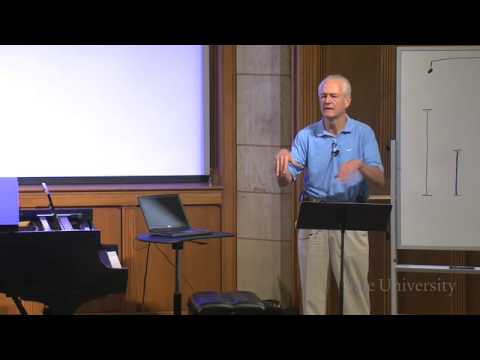
Listening to Music (MUSI 112) This lecture provides an introduction to basic classical music terminology, orchestral instruments, and acoustics. Professor Wright begins with a brief discussion of the distinctions between such broad terms as "song" and "piece," briefly mentioning more specific terms for musical genres, such as "symphony" and "opera." He then moves on to describe the differences between a "motive" and a "theme," demonstrating the distinction between the two with the use of music by Beethoven and Tchaikovsky. Following this, he calls upon three guest instrumentalists on French horn, bassoon, and viola to give a brief performance-introduction to each instrument. He concludes the session with a discussion of acoustics, focusing on the concept of partials, and then brings the lecture to a close with commentary on Richard Strauss's tone-poem, Death and Transfiguration. 00:00 - Chapter 1. Distinguishing "Songs" from "Pieces": Musical Lexicon 04:23 - Chapter 2. Genres, Motives, and Themes 16:51 - Chapter 3. Introduction to the French Horn and Partials 23:02 - Chapter 4. The Bassoon and the Viola 29:14 - Chapter 5. Mugorsky and the Basic Principles of Acoustics 40:30 - Chapter 6. Dissonance and Consonance in Strauss's Death and Transfiguration Complete course materials are available at the Yale Online website: online.yale.edu This course was recorded in Fall 2008.

Continue this lesson in the app
Install CourseHive on Android or iOS to keep learning while you move.