Summary
Keywords
Full Transcript
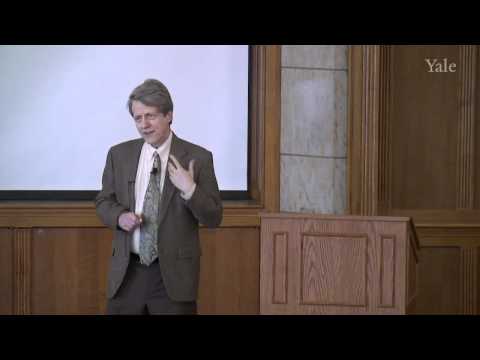
Financial Markets (2011) (ECON 252) Initially, Professor Shiller looks back at David Swensen's guest lecture, in particular with respect to the Sharpe ratio as a performance measure for investment strategies. He emphasizes the empirical difficulty to measure the standard deviation, specifically for illiquid asset classes, and elaborates on investment strategies that manipulate the Sharpe ratio. Subsequently, he focuses on the Efficient Markets Hypothesis. This theory states that markets efficiently incorporate all public information, which consequently renders beating the market impossible. For example, technical analysis fails to provide powerful, short-run profit opportunities. A consequence of the Efficient Markets Hypothesis is that stock prices follow a Random Walk, as innovations to the stock price must be solely attributable to news. Professor Shiller contrasts the behavior of a Random Walk with that of a First-Order Autoregressive Process, and concludes that the latter statistical process matches the reality of the stock market more closely. This conclusion, combined with the evidence that investment managers like David Swensen are capable of consistently outperforming the market leads Professor Shiller to the conclusion that the Efficient Markets Hypothesis is a half-truth. 00:00 - Chapter 1. Swensen's Lecture in Retrospect and Manipulations of the Sharpe Ratio 16:06 - Chapter 2. History of the Efficient Markets Hypothesis 29:10 - Chapter 3. Testing the Efficient Markets Hypothesis 40:49 - Chapter 4. Technical Analysis and the Head and Shoulders Pattern 47:04 - Chapter 5. Random Walk vs. First-Order Autoregressive Process as Stock Price Model Complete course materials are available at the Yale Online website: online.yale.edu This course was recorded in Spring 2011.

Continue this lesson in the app
Install CourseHive on Android or iOS to keep learning while you move.