Financial Markets (2011) with Robert Shiller 15. Forward and Futures Markets
15. Forward and Futures Markets Transcript and Lesson Notes
Financial Markets (2011) (ECON 252) To begin the lecture, Professor Shiller elaborates on the difference between forwards and futures and on the role of futures markets to infer future prices for the underlying commodity
Quick Summary
Financial Markets (2011) (ECON 252) To begin the lecture, Professor Shiller elaborates on the difference between forwards and futures and on the role of futures markets to infer future prices for the underlying commodity
Key Takeaways
- Review the core idea: Financial Markets (2011) (ECON 252) To begin the lecture, Professor Shiller elaborates on the difference between forwards and futures and on the role of futures markets to infer future prices for the underlying commodity
- Understand how Forwards vs. futures fits into 15. Forward and Futures Markets.
- Understand how predicting future prices fits into 15. Forward and Futures Markets.
- Understand how Chicago Mercantile Exchange fits into 15. Forward and Futures Markets.
- Understand how derivative markets fits into 15. Forward and Futures Markets.
Key Concepts
Full Transcript
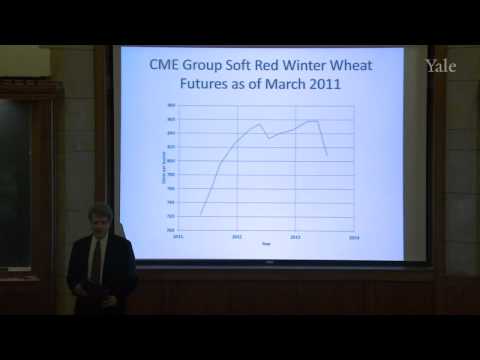
Financial Markets (2011) (ECON 252) To begin the lecture, Professor Shiller elaborates on the difference between forwards and futures and on the role of futures markets to infer future prices for the underlying commodity or financial asset. Generalizing the discussion beyond futures markets to derivatives markets, he assesses the issue of speculation in those markets and its impact on capitalist activity. Subsequently, he introduces the notions of counterparty risk, standardization of contracts, and clearinghouses within the framework of the first futures market, the market for rice futures in Dojima, Japan. While describing wheat futures, he addresses the price patterns of contango and backwardation, margin accounts that help alleviating counterparty risk, as well as the fair value formula for futures prices. The third commodity futures market is the oil futures market, which leads to description of the history of the oil market in general from the 1870s, to the first and second oil crisis, until the oil price spike in 2008. Professor Shiller concludes this lecture with financial futures, specifically S&P 500 index futures, touching upon the difference between physical delivery and cash settlement. 00:00 - Chapter 1. Forwards vs. Futures Contracts; Speculation in Derivative Markets 12:46 - Chapter 2. The First Futures Market and the Role of Standardization 23:03 - Chapter 3. Rice Futures and Contango vs. Backwardation 31:47 - Chapter 4. Counterparty Risk and Margin Accounts 37:50 - Chapter 5. Wheat Futures and the Fair Value Formula for Futures Pricing 47:00 - Chapter 6. Oil Futures 55:04 - Chapter 7. The History of the Oil Market 01:08:16 - Chapter 8. Financial Futures and the Difficulty of Forecasting Complete course materials are available at the Yale Online website: online.yale.edu This course was recorded in Spring 2011.

Lesson FAQs
What is 15. Forward and Futures Markets about?
Financial Markets (2011) (ECON 252) To begin the lecture, Professor Shiller elaborates on the difference between forwards and futures and on the role of futures markets to infer future prices for the underlying commodity
What key concepts are covered in this lesson?
The lesson covers Forwards vs. futures, predicting future prices, Chicago Mercantile Exchange, derivative markets, speculation.
What should I learn before 15. Forward and Futures Markets?
Review the previous lessons in Financial Markets (2011) with Robert Shiller, then use the transcript and key concepts on this page to fill any gaps.
How can I practice after this lesson?
Practice by applying the main concepts: Forwards vs. futures, predicting future prices, Chicago Mercantile Exchange, derivative markets.
Does this lesson include a transcript?
Yes. The full transcript is visible on this page in indexable HTML sections.
Is this lesson free?
Yes. CourseHive lessons and courses are available to learn online for free.