Course Hive
Search

Welcome

Sign in or create your account

Continue with Google
or
2. Risk and Financial Crises
Play lesson

Financial Markets (2011) with Robert Shiller - 2. Risk and Financial Crises

Master the Markets: Unravel the Intricacies of Finance and Investment with Yale's Expert Insights on Risk, Innovation, and Strategy in the Financial World

5.0 (0)
6 learners

What you'll learn

Understand the impact of financial crises and risk management in modern finance
Analyze the role of technology and innovation in financial markets
Apply principles of portfolio diversification and real estate investment strategies
Evaluate the significance of behavioral finance and psychological influences on markets

This course includes

  • 27.5 hours of video
  • Certificate of completion
  • Access on mobile and TV

Financial Markets (2011) with Robert Shiller 2. Risk and Financial Crises

2. Risk and Financial Crises Transcript and Lesson Notes

Financial Markets (2011) (ECON 252) Professor Shiller introduces basic concepts from probability theory and embeds these concepts into the concrete context of financial crises, with examples from the financial crisis fro

Quick Summary

Financial Markets (2011) (ECON 252) Professor Shiller introduces basic concepts from probability theory and embeds these concepts into the concrete context of financial crises, with examples from the financial crisis fro

Key Takeaways

  • Review the core idea: Financial Markets (2011) (ECON 252) Professor Shiller introduces basic concepts from probability theory and embeds these concepts into the concrete context of financial crises, with examples from the financial crisis fro
  • Understand how Financial return fits into 2. Risk and Financial Crises.
  • Understand how probability fits into 2. Risk and Financial Crises.
  • Understand how expected value fits into 2. Risk and Financial Crises.
  • Understand how variance fits into 2. Risk and Financial Crises.

Key Concepts

Full Transcript

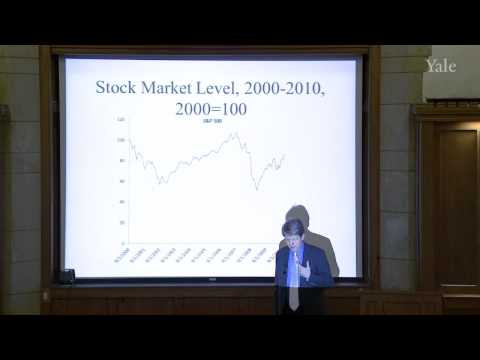
Financial Markets (2011) (ECON 252) Professor Shiller introduces basic concepts from probability theory and embeds these concepts into the concrete context of financial crises, with examples from the financial crisis from 2007-2008. Subsequent to a historical narrative of the financial crisis from 2007-2008, he turns to the definition of the expected value and the variance of a random variable, as well as the covariance and the correlation of two random variables. The concept of independence leads to the law of large numbers, but financial crises show that the assumption of independence can be deceiving, in particular through its impact on the computation of Value at Risk measures. Moreover, he covers regression analysis for financial returns, which leads to the decomposition of a financial asset's risk into idiosyncratic and systematic risk. Professor Shiller concludes by talking about the prominent assumption that random shocks to the financial economy are normally distributed. Historical stock market patterns, specifically during crises times, establish that outliers occur too frequently to be compatible with the normal distribution. 00:00 - Chapter 1. Financial Crisis of 2007-2008 and Its Connection to Probability Theory 05:51 - Chapter 2. Introduction to Probability Theory 09:58 - Chapter 3. Financial Return and Basic Statistical Concepts 26:29 - Chapter 4. Independence and Failure of Independence as a Cause for Financial Crises 38:58 - Chapter 5. Regression Analysis, Systematic vs. Idiosyncratic Risk 58:59 - Chapter 6. Fat-Tailed Distributions and their Role during Financial Crises Complete course materials are available at the Yale Online website: online.yale.edu This course was recorded in Spring 2011.

Lesson FAQs

What is 2. Risk and Financial Crises about?

Financial Markets (2011) (ECON 252) Professor Shiller introduces basic concepts from probability theory and embeds these concepts into the concrete context of financial crises, with examples from the financial crisis fro

What key concepts are covered in this lesson?

The lesson covers Financial return, probability, expected value, variance, standard deviation.

What should I learn before 2. Risk and Financial Crises?

Review the previous lessons in Financial Markets (2011) with Robert Shiller, then use the transcript and key concepts on this page to fill any gaps.

How can I practice after this lesson?

Practice by applying the main concepts: Financial return, probability, expected value, variance.

Does this lesson include a transcript?

Yes. The full transcript is visible on this page in indexable HTML sections.

Is this lesson free?

Yes. CourseHive lessons and courses are available to learn online for free.

Continue Learning

Course Hive

Continue this lesson in the app

Install CourseHive on Android or iOS to keep learning while you move.

Related Lessons

Related Courses

FAQs

Course Hive
Download CourseHive and keep learning anywhere
Get App