Summary
Keywords
Full Transcript
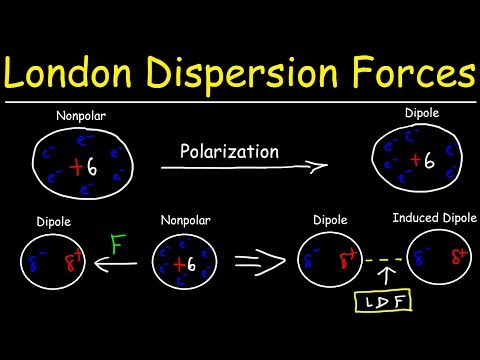
This chemistry video tutorial provides a basic introduction into London dispersion forces also known Van Der Waals forces. London dispersion forces arise from the electrostatic interactions between temporary dipoles and induced dipoles. A dipole is a polarized particle that contains a separation of charge - one part of the particle is partially positive, and the other part is partially positive. Polar molecules contain permanent dipoles. Nonpolar molecules do not usually contain a dipole moment but can become a temporary dipole due to the distortion of the electron cloud. Atoms and molecules with a large number of electrons are highly polarizable, that is, they have a higher probability of turning into a temporary dipole. A dipole can cause another molecule to turn into a temporary dipole. This is known as an induced dipole. The interactions between temporary instantaneous dipoles and induced dipoles are known as van der waals interactions or london dispersion forces. Large molecules have a high amount of london dispersion forces and therefore have higher boiling points than smaller molecules. Boiling point is directly related to the amount of van der waal interactions among molecules. Chemistry - Free Formula Sheets: https://www.video-tutor.net/chemistry-formula-sheets.html Chemistry 1 Final Exam Review: https://www.youtube.com/watch?v=5yw1YH7YA7c Chapter 10 - Video Lessons: https://www.video-tutor.net/liquids-and-solids.html Final Exam and Test Prep Videos: https://bit.ly/41WNmI9 ________________________________ Lewis Structures - Mega Review: https://www.youtube.com/watch?v=PeY_sihSh8E Sigma and Pi Bonding: https://www.youtube.com/watch?v=pT8nrBrTOm4 Hybridization of Atomic Orbitals: https://www.youtube.com/watch?v=pdJeQUd2g_4 Molecular Orbital Theory: https://www.youtube.com/watch?v=6tB6E6R_XpQ Dipole Dipole Forces of Attraction: https://www.youtube.com/watch?v=zOvnu0KYyxo _______________________________ Hydrogen Bonding: https://www.youtube.com/watch?v=ZDjJOqOKeCI London Dispersion Forces: https://www.youtube.com/watch?v=yIuJfHOVh48 Ion Dipole Forces: https://www.youtube.com/watch?v=DwNmEc9x1U4 Bragg's Equation For X-Ray Diffraction: https://www.youtube.com/watch?v=Cjce4QumZNk Molecular & Network Covalent Solids: https://www.youtube.com/watch?v=O82d8aiIS5Y _______________________________ Metallic Bonding: https://www.youtube.com/watch?v=ileXLAvDXIU Metal Alloys: https://www.youtube.com/watch?v=waLo6Yqtsug Diamond Vs Graphite: https://www.youtube.com/watch?v=Anu2evOTnBU Semiconductors: https://www.youtube.com/watch?v=ethnHSgVbHs Unit Cell Chemistry: https://www.youtube.com/watch?v=HCWwRh5CXYU _________________________________ Final Exams and Video Playlists: https://www.video-tutor.net/ Full-Length Videos and Worksheets: https://www.patreon.com/MathScienceTutor/collections Chemistry PDF Worksheets: https://www.video-tutor.net/chemistry-basic-introduction.html

Continue this lesson in the app
Install CourseHive on Android or iOS to keep learning while you move.