
Summary
Keywords
Full Transcript
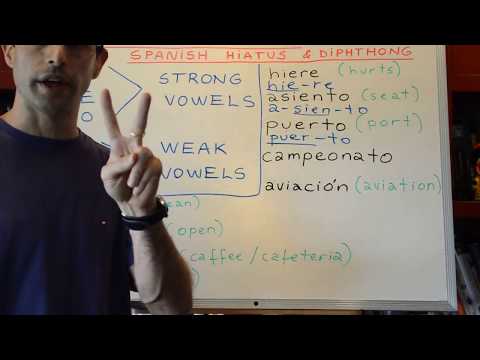
You can find all my lessons at http://www.spanishfreelessonsonline.com/list-lessons/ or at https://www.youtube.com/watch?v=8J281hMF2oE&list=PLKQEL9j11yiUQ5SWdkc6ZT6A1NRoaskst Facebook: https://www.facebook.com/groups/339902716169323/ In our lesson Nbr. 294 I taught the 1st of the 4 Spanish accent rules. In order to learn the 2nd one, it is imperative to learn and go through Spanish diphthongs and hiatus. Before learning what Spanish diphthongs and hiatus are, we need to learn that Spanish vowels are separated in 2 different categories: Strong & Weak STRONG VOWEL: A, E, O WEAK VOWELS: I, U What is a DIPHTHONG: We have a diphthong when two vowels that go together in the same word, remain together in the same syllable. What is a HIATUS: We have a hiatus when two vowels that go together in the same word, are separated each one in a different syllable. Lets think of vowels in this way: When we separate a word in syllables, weak vowels cannot be separated form their partner. Why? Lets say that just because they are "weak". Strong vowels can be split, because they are "strong" (this is the most intuitive way of thinking of it and understanding the rules). When do we have SPANISH DIPHTHONGS: A diphthongs applies when a word has two vowels together, and these vowels are either: - 1 strong vowel + 1 weak vowel - 2 weak vowels Per the rule we just mentioned, a weak vowel cannot be split from her partner vowel. Therefore, here the vowels need to stay together in the same syllable. Thus, we have a Spanish diphthong. When do we have a SPANISH HIATUS: A hiatus applies when a word has two vowels together, and these vowels are 2 strong vowels. Since strong vowels can be split from their partner-vowel, then these 2 strong vowels are separated into 2 different syllables. Thus, we have a Spanish hiatus. OBSERVATION: If the stress of the word is on a weak vowel, then this vowel behaves as a strong vowel. Thus, instead of a diphthong we may have a hiatus, because a weak vowel became "strong" (and this weak vowel therefore should carry a Spanish accent). Examples of Spanish diphthongs: abierto (a-bier-to) - open cambio (cam-bio) - change / exchange puerta (puer-ta) - door vuelo (vue-lo) - flight cien (cien) - hundred puerto (puer-to) - port / harbor aeropuerto (a-e-ro-puer-to) - airport Examples of Spanish hiatus: aeropuerto (a-e-ro-puer-to) - airport había (ha-bí-a) - there was vía (ví-a) - route - way campeonato (cam-pe-o-na-to) - championship raíz (ra-íz) - root heladería (he-la-de-rí-a) - ice-cream parlor tío (tí-o) - uncle tía (tí-a) - aunt

Continue this lesson in the app
Install CourseHive on Android or iOS to keep learning while you move.




