Summary
Keywords
Full Transcript
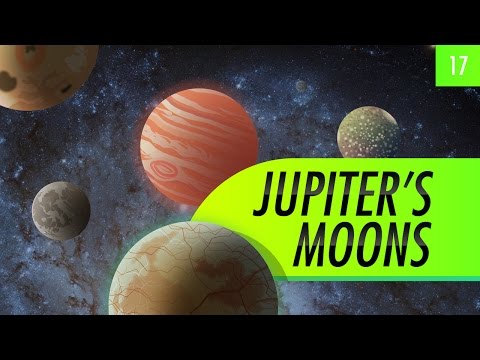
Before moving on from Jupiter to Saturn, we’re going to linger for a moment on Jupiter’s moons. There are 67 known moons, 4 of which are the huge ones that we want to explore in greater detail. Ganymede is the largest - larger, in fact, than any other moon in the solar system and the planet Mercury! Callisto, orbiting the farthest out, is smaller but quite similar to Ganymede in many ways. Io, meanwhile, is most noteworthy for its tremendous volcanic activity. There’s also water on Ganymede and Europa! This episode was brought to you by Squarespace http://www.squarespace.com/crashcourse Check out the Crash Course Astronomy solar system poster here: http://store.dftba.com/products/crashcourse-astronomy-poster -- Chapters: Introduction: Jupiter's Moons 00:00 Ganymede: Jupiter's Largest Moon 1:15 Callisto: Jupiter's Second Largest Moon 2:15 Io: Volcanoes! 2:59 Europa: The Ocean Moon 4:48 The Habitable Zone 7:05 Jupiter's Other Moons 7:49 Review 9:33 -- PBS Digital Studios: http://youtube.com/pbsdigitalstudios Follow Phil on Twitter: https://twitter.com/badastronomer Crash Course is on Patreon! You can support us directly by signing up at http://www.patreon.com/crashcourse Want to find Crash Course elsewhere on the internet? Facebook - http://www.facebook.com/YouTubeCrashCourse Twitter - http://www.twitter.com/TheCrashCourse Instagram - https://www.instagram.com/thecrashcourse/ CC Kids: http://www.youtube.com/crashcoursekids -- PHOTO/VIDEO SOURCES Galileo’s notebook http://hos.ou.edu/exhibits/exhibit.php?exbid=4 [credit: Image(s) courtesy History of Science Collections, University of Oklahoma Libraries; copyright the Board of Regents of the University of Oklahoma.] Jupiter’s moons http://photojournal.jpl.nasa.gov/jpeg/PIA00600.jpg [credit: NASA/JPL/DLR] Ganymede http://svs.gsfc.nasa.gov/vis/a010000/a011100/a011173/Image4_1920x1080.jpg [credit: NASA/JPL/Ted Stryk] Interior of Ganymede https://commons.wikimedia.org/wiki/File:PIA00519_Interior_of_Ganymede.jpg [credit: Wikimedia Commons / NASA] Ganymede terrain https://commons.wikimedia.org/wiki/File:Ganymede_terrain.jpg [credit: Wikimedia Commons / NASA] Artist Conception of Ganymede http://www.nasa.gov/content/goddard/hubbles-view-of-ganymede-briefing-materials/ (Figure 5) [credit: NASA/ESA] Callisto http://photojournal.jpl.nasa.gov/jpeg/PIA03456.jpg [credit: NASA/JPL/DLR] Interior of Callisto https://en.wikipedia.org/wiki/Callisto_(moon)#/media/File:PIA01478_Interior_of_Callisto.jpg [credit: Wikimedia Commons / NASA] Valhalla crater on Callisto https://commons.wikimedia.org/wiki/File:Valhalla_crater_on_Callisto.jpg [credit: Wikimedia Commons / NASA / JPL] Io http://svs.gsfc.nasa.gov/vis/a010000/a011400/a011455/s1-1920.jpg [credit: NASA/JPL/USGS] Io volcano image http://solarviews.com/browse/jup/ioplumedisc.jpg [credit: NASA/JPL] Io eruption video http://svs.gsfc.nasa.gov/vis/a010000/a011400/a011455/IO_Eruption-540-MASTER_high.mp4 [credit: NASA/Johns Hopkins University Applied Physics Laboratory/Southwest Research Institute] Io surface http://svs.gsfc.nasa.gov/vis/a010000/a011400/a011455/s2-1204.jpg [credit: NASA/JPL/University of Arizona] Jupiter Magnetosphere Schema https://en.wikipedia.org/wiki/Io_(moon)#/media/File:Jupiter_magnetosphere_schematic.jpg [credit: Wikimedia Commons / Volcanopele] Jupiter aurora http://www.spacetelescope.org/static/archives/images/large/heic0009a.jpg [credit: NASA, ESA & John T. Clarke (Univ. of Michigan)] Europa http://photojournal.jpl.nasa.gov/jpeg/PIA19048.jpg [credit: NASA/JPL-Caltech/SETI Institute] Europa ocean http://apod.nasa.gov/apod/image/1205/EuropasOcean_KPHand003.jpg [credit: NASA/JPL/Kevin Hand Habitable zone diagram http://www.keckobservatory.org/images/made/images/gallery/solar_system/Slides-8_1800_1350.jpg [credit: PETIGURA/UC BERKELEY, HOWARD/UH-MANOA, MARCY/UC BERKELEY] Amalthea http://photojournal.jpl.nasa.gov/jpeg/PIA02532.jpg [c redit: NASA/JPL/Cornell University]

Continue this lesson in the app
Install CourseHive on Android or iOS to keep learning while you move.