Summary
Keywords
Full Transcript
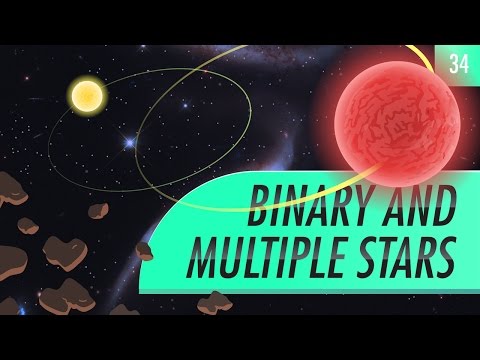
Double stars are stars that appear to be near each other in the sky, but if they’re gravitationally bound together we call them binary stars. Many stars are actually part of binary or multiple systems. If they are close enough together they can actually touch other, merging into one peanut-shaped star. In some close binaries, matter can flow from one star to the other, changing the way it ages. If one star is a white dwarf, this can cause periodic explosions, and possibly even lead to blowing up the entire star. Check out the Crash Course Astronomy solar system poster here: http://store.dftba.com/products/crashcourse-astronomy-poster -- Chapters: Introduction: Binary & Multiple Stars 00:00 Visual Binary Stars 1:45 Spectroscopic Binaries 3:05 Multiple Star Systems 4:15 Eclipsing Binaries 5:44 Contact Binaries 6:53 Stellar Novae 8:31 Review 10:50 -- PBS Digital Studios: http://youtube.com/pbsdigitalstudios Follow Phil on Twitter: https://twitter.com/badastronomer Want to find Crash Course elsewhere on the internet? Facebook - http://www.facebook.com/YouTubeCrashCourse Twitter - http://www.twitter.com/TheCrashCourse Tumblr - http://thecrashcourse.tumblr.com Support CrashCourse on Patreon: http://www.patreon.com/crashcourse -- PHOTOS/VIDEOS Big Dipper http://www.deepskycolors.com/archive/2011/05/14/The-Big-Dipper.html [credit: Rogelio Bernal Andreo] Sirius https://www.spacetelescope.org/images/heic0516a/ [credit: NASA, ESA, H. Bond (STScI), and M. Barstow (University of Leicester)] Sirius A and B http://chandra.harvard.edu/photo/2000/0065/index.html [credit: NASA/SAO/CXC] Clashing Winds (video) http://svs.gsfc.nasa.gov/cgi-bin/details.cgi?aid=11680 [credit: NASA's Goddard Space Flight Center] The Radial Velocity Method (artist’s impression) http://www.eso.org/public/images/eso0722e/ [credit: ESO] Mizar+Alcor https://commons.wikimedia.org/wiki/File:Thomas_Bresson_-_Mizar%2Balcor_(by).jpg [credit: Wikimedia Commons, Thomas Bresson] Polaris http://imgsrc.hubblesite.org/hu/db/images/hs-2006-02-e-print.jpg [credit: NASA, ESA, and G. Bacon] Does the Sun Have Long Lost Siblings? https://www.youtube.com/watch?v=IaWg2ACMspk [credit: SciShow Space] Clashing Winds (image) http://svs.gsfc.nasa.gov/cgi-bin/details.cgi?aid=11680 [credit: NASA/C. Reed X-ray images courtesy of NASA/GSFC/S. Immler] Artist’s impression of the pulsar PSR J0348+0432 and its white dwarf companion http://www.eso.org/public/images/eso1319c/ [credit: ESO/L. Calçada] Artist’s impression of eclipsing binary http://www.eso.org/public/videos/eso1311b/ [credit: ESO/L. Calçada] Artist’s impression of the yellow hypergiant star HR 5171 http://www.eso.org/public/images/eso1409b/ [credit: ESO] Nova http://www.nasa.gov/centers/goddard/news/topstory/2008/keck_ophiuchi_prt.htm [credit: NASA, Casey Reed] Artist's impression of RS Ophiuchi http://www.jodrellbank.manchester.ac.uk/news/2006/rsoph-radio/ [credit: David A. Hardy/http://www.astroart.org & PPARC] An artist's impression of Sirius A and B http://www.spacetelescope.org/images/heic0516b/ [credit: NASA, ESA and G. Bacon (STScI)] Artist's impression of vampire star http://www.spacetelescope.org/videos/astro_bn/ [credit: ESO/M. Kornmesser] Type Ia supernova http://svs.gsfc.nasa.gov/cgi-bin/details.cgi?aid=10532 [credit: Walt Feimer, NASA/Goddard Space Flight Center]

Continue this lesson in the app
Install CourseHive on Android or iOS to keep learning while you move.