Summary
Keywords
Full Transcript
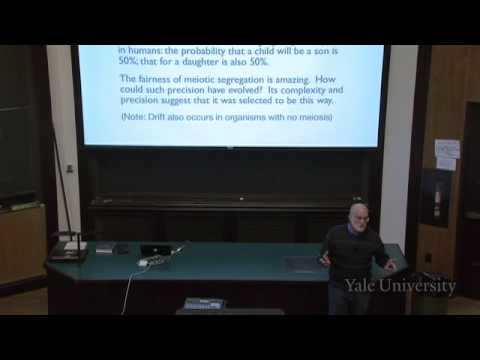
Principles of Evolution, Ecology and Behavior (EEB 122) Neutral evolution occurs when genes do not experience natural selection because they have no effect on reproductive success. Neutrality arises when mutations in an organism's genotype cause no change in its phenotype, or when changes in the genotype bring about changes in the phenotype that do not affect reproductive success. Because neutral genes do not change in any particular direction over time and simply "drift," thanks in part to the randomness of meiosis, they can be used as a sort of molecular clock to determine common ancestors or places in the phylogenetic tree of life. 00:00 - Chapter 1. Introduction 04:56 - Chapter 2. Genes and Amino Acid Changes Not Reflected in Phenotypes 14:29 - Chapter 3. Neutral Evolution in the History of Life 20:38 - Chapter 4. Mechanisms of Neutral or Random Evolution 35:28 - Chapter 5. The Molecular Clock of Neutral Evolution Complete course materials are available at the Open Yale Courses website: http://open.yale.edu/courses This course was recorded in Spring 2009.

Continue this lesson in the app
Install CourseHive on Android or iOS to keep learning while you move.