
Summary
Keywords
Full Transcript
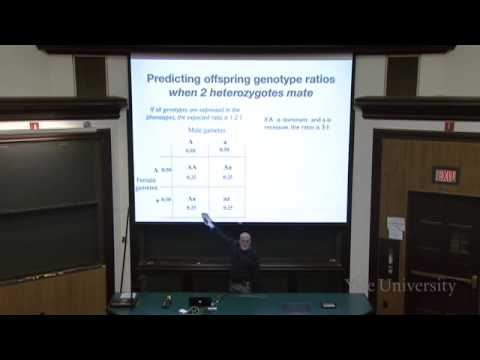
Principles of Evolution, Ecology and Behavior (EEB 122) Genetic transmission is the mechanism that drives evolution. DNA encodes all the information necessary to make an organism. Every organism's DNA is made of the same basic parts, arranged in different orders. DNA is divided into chromosomes, or groups of genes, which code for proteins. Asexually reproducing organisms reproduce using mitosis, while sexually reproducing organisms reproduce using meiosis. Both these mechanisms involve duplication of DNA, which then gets passed to offspring. RNA is a key component in the duplication of DNA. 00:00 - Chapter 1. Introduction 01:29 - Chapter 2. Structure of DNA and Genetic Material 12:51 - Chapter 3. DNA Replication and Its Implications 25:56 - Chapter 4. Mendel's Laws 33:08 - Chapter 5. Mutations and Their Consequences Complete course materials are available at the Open Yale Courses website: http://open.yale.edu/courses This course was recorded in Spring 2009.

Continue this lesson in the app
Install CourseHive on Android or iOS to keep learning while you move.


![[Complete] Human Behavioral Biology - Sapolsky (Stanford)](https://i.ytimg.com/vi/NNnIGh9g6fA/hqdefault.jpg)