Summary
Keywords
Full Transcript
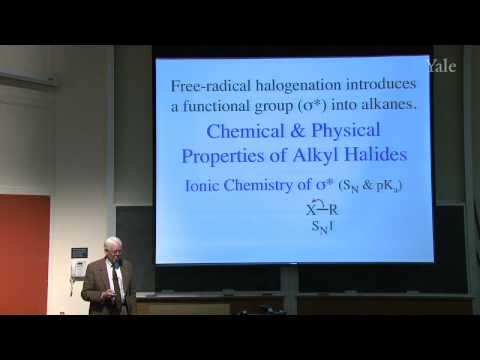
Freshman Organic Chemistry II (CHEM 125B) A student provides insight on fractional-order rate laws. Bonds involving atoms with lone-pair electrons are weakened by electron-pair repulsion. Electronegativity differences between atoms make ionic dissociation (heterolysis) easier and radical dissociation (homolysis) harder, although Pauling's definition of electronegativity makes the logic of the latter effect somewhat circular. The course transitions from free-radical reactions to ionic reactions by discussing solvent properties, in particular the electrostatic properties of alkyl halides and alkanes.. 00:00 - Chapter 1. Generalization of Fractional-Order Rate Laws 03:44 - Chapter 2. Electron-Pair Repulsion and Bond Dissociation Energy 07:48 - Chapter 3. Heterolysis and Homolysis - Pauling's Electronegativity and Bond Dissociation Energy 27:04 - Chapter 4. Alkyl Halides -- Electrostatics, Non-bonded Interactions, and Solvent Properties Complete course materials are available at the Open Yale Courses website: http://oyc.yale.edu This course was recorded in Spring 2011.

Continue this lesson in the app
Install CourseHive on Android or iOS to keep learning while you move.