
Summary
Keywords
Full Transcript
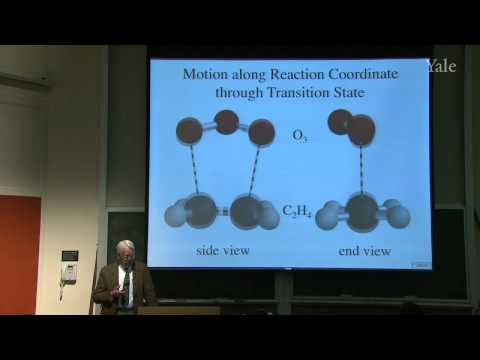
Freshman Organic Chemistry II (CHEM 125B) The formation of epoxides and the regiospecificity of their acid- and base-catalyzed ring openings underlines the importance of thinking carefully about how textbooks draw curved arrows and may sometimes read too much into fundamentally inadequate experimental data. The ozonolysis of alkenes begins with several 1,3-dipolar cycloadditions that can be understood in terms of matching HOMOs with LUMOs of the corresponding symmetry. The process continues with acetal hydrolysis and either reduction or oxidation to obtain the desired product. Mechanisms of these typical reactions are analyzed. Although addition to the C=O double bond is usually considered nucleophilic, it can have an important electrophilic component that makes it mechanistically analogous to the "electrophilic" additions to C=C being discussed in these lectures. The use of metals to access orbitals of the proper symmetry is introduced through alkene dihydroxylation via cycloaddition of OsO4. 00:00 - Chapter 1. Regiospecificity in Epoxide Opening: Interpreting Experimental Data 16:02 - Chapter 2. Ozonolysis and 1,3-Dipolar Cycloaddition 32:59 - Chapter 3. Acetal Hydrolysis and the Completion of Ozonolysis 46:02 - Chapter 4. Electrophilic Participation in Nucleophilic Attack on C=O 48:02 - Chapter 5. Cycloaddition for Dihydroxylation Complete course materials are available at the Open Yale Courses website: http://oyc.yale.edu This course was recorded in Spring 2011.

Continue this lesson in the app
Install CourseHive on Android or iOS to keep learning while you move.

