
Summary
Keywords
Full Transcript
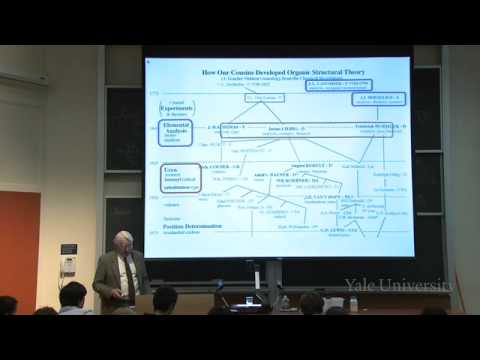
Freshman Organic Chemistry (CHEM 125) The most prominent chemist in the generation following Lavoisier was Berzelius in Sweden. Together with Gay-Lussac in Paris and Davy in London, he discovered new elements, and improved atomic weights and combustion analysis for organic compounds. Invention of electrolysis led not only to new elements but also to the theory of dualism, with elements being held together by electrostatic attraction. Wöhler's report on the synthesis of urea revealed isomerism but also persistent naiveté about treating quantitative data. In their collaborative investigation of oil of bitter almonds Wöhler and Liebig extended dualism to organic chemistry via the radical theory. 00:00 - Chapter 1. Confusion over Silicon Chloride: Discussion on Atomic Weights and Equivalents 06:06 - Chapter 2. Combustion Analysis and the Beginnings of Electrolysis 15:56 - Chapter 3. Dualism: An Organizing Principle 23:07 - Chapter 4. The Honest Experimenter and the Persistent Naivety on Quantitative Data 29:18 - Chapter 5. Ammonium Cyanate, Urea, and the Idea of Isomerism 38:31 - Chapter 6. Wohler, Liebig, and Transmission of Dualism via the Radical Theory Complete course materials are available at the Open Yale Courses website: http://open.yale.edu/courses This course was recorded in Fall 2008.

Continue this lesson in the app
Install CourseHive on Android or iOS to keep learning while you move.

