Summary
Keywords
Full Transcript
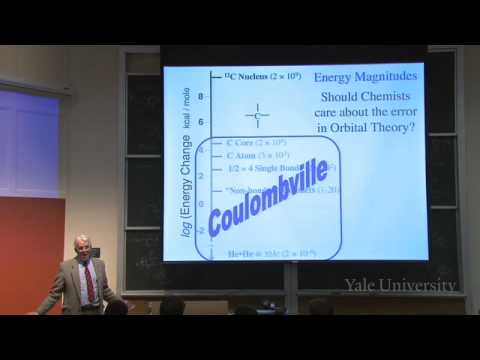
Freshman Organic Chemistry (CHEM 125) The lecture opens with tricks ("Z-effective" and "Self Consistent Field") that allow one to correct approximately for the error in using orbitals that is due to electron repulsion. This error is hidden by naming it "correlation energy." Professor McBride introduces molecules by modifying J.J. Thomson's Plum-Pudding model of the atom to rationalize the form of molecular orbitals. There is a close analogy in form between the molecular orbitals of CH4 and NH3 and the atomic orbitals of neon, which has the same number of protons and neutrons. The underlying form due to kinetic energy is distorted by pulling protons out of the Ne nucleus to play the role of H atoms. 00:00 - Chapter 1. Introduction 01:53 - Chapter 2. Correcting for Electron Repulsion when Using Orbitals 15:26 - Chapter 3. Correlation Energy and the Limits of Orbital Theory 30:52 - Chapter 4. Kinetic Energy's Effects on the Shapes of Atomic Orbitals 40:32 - Chapter 5. Moving Nuclei to Distort "Electric Puddings": Case Studies with Methane and Ammonia Complete course materials are available at the Open Yale Courses website: http://open.yale.edu/courses This course was recorded in Fall 2008.

Continue this lesson in the app
Install CourseHive on Android or iOS to keep learning while you move.