Summary
Keywords
Full Transcript
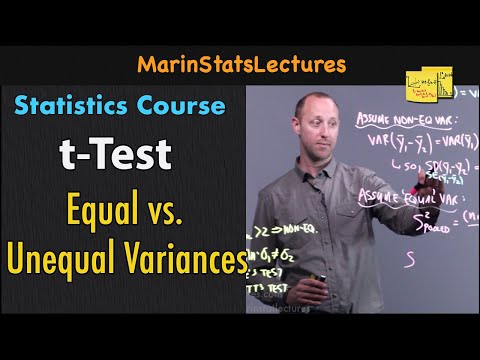
Two Sample t-Test: Equal vs Unequal Variance Assumption: Learn about the assumption of equal variance (or standard deviation) vs non-equal variance (or standard deviation) in data analysis. To learn more about 2 Sample t-Test watch this https://goo.gl/MWLAua -and for conducting 2 Sample t-Test with R l https://goo.gl/rVzjyf👍🏼Best Statistics & R Programming Language Tutorials: ( https://goo.gl/4vDQzT ) ►► Like to support us? You can Donate (https://bit.ly/2CWxnP2), Share our Videos, Leave us a Comment and Give us a Like! Either way We Thank You! For more Statistics and R Programming Tutorials: https://goo.gl/4vDQzT - 2 Sample t-Test Tutorial https://goo.gl/MWLAua -2 Sample t-Test R Tutorial https://goo.gl/rVzjyf In this statistics tutorial, we learn about the assumption of equal variance (or standard deviation) vs non-equal variance (or standard deviation). When working with the 2 sample t-test, we must make one of those two assumptions. We also learn how to decide if we can assume equal variance or if we should assume unequal variance. We cover making this decision both in a subjective way, as well as describing more formal tests that can be used. Assuming equal variance is also referred to as 'pooling', or a 'pooled estimate' of the variance. This video also shows how to calculate the standard error for the difference in means under each of the assumptions, although the focus is on what each assumption means, in concept, and not on the calculations. ►► Watch More: ► Statistics Course for Data Science https://bit.ly/2SQOxDH ►R Course for Beginners: https://bit.ly/1A1Pixc ►Getting Started with R using R Studio (Series 1): https://bit.ly/2PkTneg ►Graphs and Descriptive Statistics in R using R Studio (Series 2): https://bit.ly/2PkTneg ►Probability distributions in R using R Studio (Series 3): https://bit.ly/2AT3wpI ►Bivariate analysis in R using R Studio (Series 4): https://bit.ly/2SXvcRi ►Linear Regression in R using R Studio (Series 5): https://bit.ly/1iytAtm ►ANOVA Statistics and ANOVA with R using R Studio : https://bit.ly/2zBwjgL ►Hypothesis Testing Videos: https://bit.ly/2Ff3J9e ►Linear Regression Statistics and Linear Regression with R : https://bit.ly/2z8fXg1 Follow MarinStatsLectures Subscribe: https://goo.gl/4vDQzT website: https://statslectures.com Facebook: https://goo.gl/qYQavS Twitter: https://goo.gl/393AQG Instagram: https://goo.gl/fdPiDn Our Team: Content Creator: Mike Marin (B.Sc., MSc.) Senior Instructor at UBC. Producer and Creative Manager: Ladan Hamadani (B.Sc., BA., MPH) These videos are created by #marinstatslectures to support some statistics courses at the University of British Columbia (UBC) (#IntroductoryStatistics and #RVideoTutorials ), although we make all videos available to the everyone everywhere for free. Thanks for watching! Have fun and remember that statistics is almost as beautiful as a unicorn! #statistics #rprogramming

Continue this lesson in the app
Install CourseHive on Android or iOS to keep learning while you move.