Summary
Keywords
Full Transcript
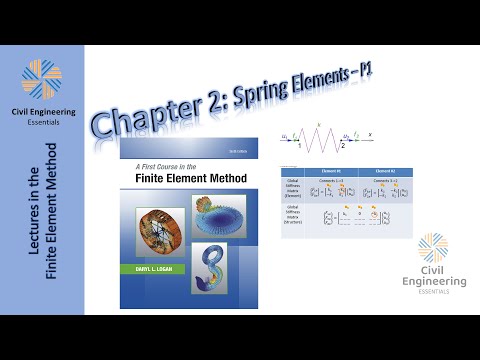
In this comprehensive tutorial, we'll take a deep dive into chapter 2 of the book "A first course in the finite element method" including the direct stiffness method for structural analysis. We'll start by explaining the difference between global and local stiffness, and then move on to the spring local stiffness concept. We'll also provide a detailed example to help you understand the method better. Next, we'll explain the direct stiffness method and provide another example to help you understand how it works. We'll then move on to the assembly of global stiffness and explain how to apply boundary conditions. Finally, we'll provide a full example to help you see the direct stiffness method in action. Whether you're a beginner or an experienced engineer, this tutorial will provide you with a solid understanding of the direct stiffness method and how to apply it to solve structural analysis problems. So, sit back, relax, and let's get started! Timestamps: 0:00 Introduction 4:31 Global vs Local 7:15 Spring Local Stiffness 26:35 Example 28:04 Direct Stiffness Method 29:35 Example Cont'd 32:07 Assembly of Global Stiffness 40:43 Boundary Conditions 43:40 Application of BC 48:11 Full Example 1:04:07 Outro #Finite Element Method #FEM #engineering #science #numerical methods #discretization #interpolation #numerical integration #software #modeling #analysis #boundary conditions #a first course in the finite element method #daryl l logan

Continue this lesson in the app
Install CourseHive on Android or iOS to keep learning while you move.