Summary
Full Transcript
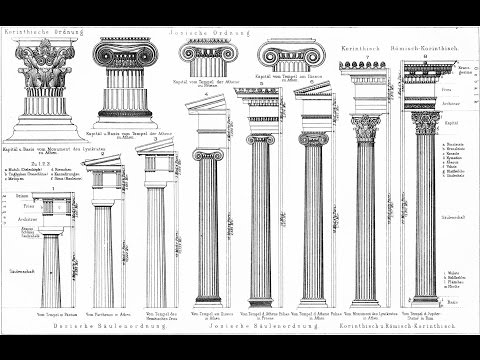
A conversation with Dr. Steven Zucker & Dr. Beth Harris In classical architecture, the Orders consist of variations of an assembly of parts made up of a column (usually with a base), a capital, and an entablature. These structural units may be repeated and combined to form the elevation of a building and its architectural vocabulary. There are eight Orders in total: Doric (Greek and Roman versions), Tuscan, Ionic (Greek and Roman), Corinthian (Greek and Roman), and Composite. The simplest is the Tuscan, supposedly derived from the Etruscan-type temple. It has a base and capital and a plain column. The Doric is probably earlier, however, its Greek version having no base, as on the Parthenon. The Ionic Order, with its twin volute capitals, originated in Asia Minor in the mid-6th century B.C.E. The Corinthian Order was an Athenian invention of the 5th century B.C.E. and was later developed by the Romans. The Composite Order is a late Roman combination of elements from the Ionic and Corinthian Orders. The Concise Oxford Dictionary of Art Terms, Michael Clarke, Deborah Clarke. © 2012 Oxford University Press. Available at Oxford Art OnlineAncient Greece . Created by Beth Harris and Steven Zucker.

Continue this lesson in the app
Install CourseHive on Android or iOS to keep learning while you move.