
Summary
Keywords
Full Transcript
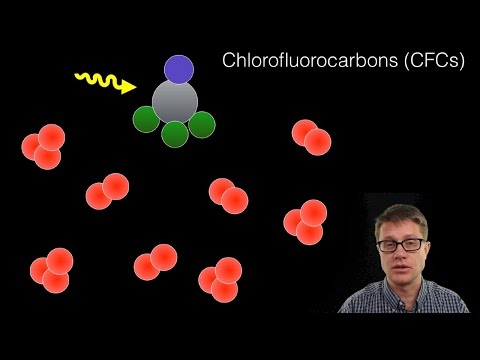
033 - Stratospheric Ozone In this video Paul Andersen explains how stratospheric ozone protects humans from ultraviolet light. He explains how stratospheric ozone is formed when diatomic oxygen absorbs an ultraviolet photon and is split into two free oxygen atoms. The free atoms bond with another oxygen molecule to form an ozone molecule creating a stable ozone layer. He then explains how chlorine atoms released from chlorofluorocarbon molecules act as an enzyme to breakdown up to 100,000 ozone molecules. The Montreal Protocol was a treaty signed by countries on the planet to reduce the amount of CFCs in the atmosphere to protect the ozone layer. Do you speak another language? Help me translate my videos: http://www.bozemanscience.com/translations/ Music Attribution Intro Title: I4dsong_loop_main.wav Artist: CosmicD Link to sound: http://www.freesound.org/people/CosmicD/sounds/72556/ Creative Commons Atribution License Outro Title: String Theory Artist: Herman Jolly http://sunsetvalley.bandcamp.com/track/string-theory All of the images are licensed under creative commons and public domain licensing: Environment, D. of the. (2008, June 24). Montreal Protocol on Substances that Deplete the Ozone Layer - Graphs [Text]. Retrieved January 8, 2016, from https://www.environment.gov.au/protection/ozone/montreal-protocol/graphs NASA. (Unknown date). Levels of ozone at various altitudes, and related blocking of several types of ultraviolet radiation. Retrieved from https://commons.wikimedia.org/wiki/File:Ozone_altitude_UV_graph.svg NASA. (2006). English: From September 21-30, 2006 the average area of the ozone hole was the largest ever observed, at 10.6 million square miles (27.5 million square kilometres). Retrieved from https://commons.wikimedia.org/wiki/File:NASA_and_NOAA_Announce_Ozone_Hole_is_a_Double_Record_Breaker.png Spigget. (2007). English: Three portraits with different spectral responses. Ultraviolet on the left (335-365nm) Visible in the middle (440-640nm) and Infrared on the right (720-850nm). Retrieved from https://commons.wikimedia.org/wiki/File:UV_Vis_IR_Portrait.jpg Spigget. (2010). English: Two photographs of a man wearing sunscreen (spf 50) on one half of his face, in visible light (left) and ultraviolet light (UV-A, 340-355nm) (right). The sunscreen on the right side (your left) of his face absorbs ultraviolet, making that side appear darker in the UV picture. Retrieved from https://commons.wikimedia.org/wiki/File:UV_and_Vis_Sunscreen.jpg Studio, N. S. F. C. S. V. (2009). English: NASA projection from 1974 to 2060 of the impact of CFCs on the Ozone layer if they hadn’t been banned. Retrieved from https://commons.wikimedia.org/wiki/File:Future_ozone_layer_concentrations.gif

Continue this lesson in the app
Install CourseHive on Android or iOS to keep learning while you move.


![Data Science Playlist [2026 Updated] | Data Science Tutorial For Beginners | Data Science Course | Data Science Training Videos | Simplilearn](https://i.ytimg.com/vi/X3paOmcrTjQ/hqdefault.jpg)


