Summary
Keywords
Full Transcript
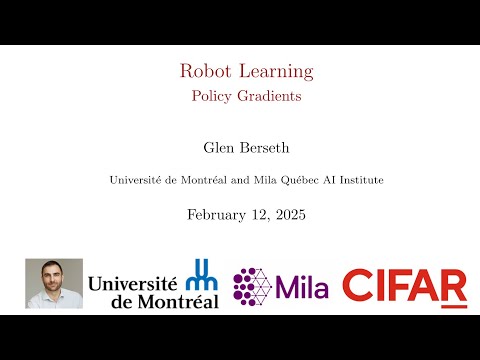
I continue reviewing policy gradients, highlighting the importance of variance reduction in gradient estimation and introducing concepts like reward-to-go and critics (value and Q-functions) to improve baseline estimates. I discuss the bias-variance trade-off in critic design and explain how combining model-based and data-driven approaches through N-step returns can enhance policy learning. Glen emphasizes the practical challenges of applying policy gradients with deep learning, pointing to a blog post detailing crucial implementation details. He then delves into the AlphaStar project, showcasing how supervised learning, TD-Lambda, V-trace, and distributed RL training were combined to successfully train a complex policy for StarCraft. The discussion also touches on the challenges of training RL agents in vast state spaces and the computational resources required for such tasks.

Continue this lesson in the app
Install CourseHive on Android or iOS to keep learning while you move.