Summary
Full Transcript
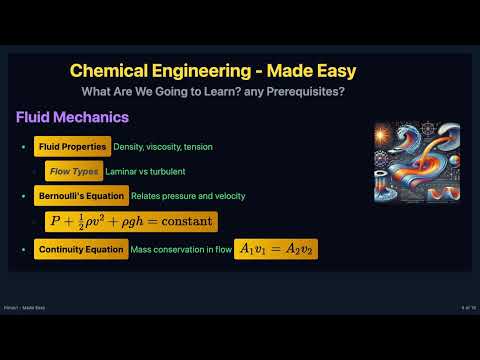
#ChemicalEngineering #STEMEducation #EngineeringBasics #Thermodynamics #FluidMechanics Watch all videos in this series via https://www.youtube.com/playlist?list=PLWzMmQBgv86-kARBq8dQSvq4SNHjfu_gv Welcome to the world of Chemical Engineering! 🌍 In this video, we introduce the core topics you'll encounter in your first year. From basic chemistry and thermodynamics to fluid mechanics and chemical kinetics, this guide will help you understand the fundamentals. You'll also explore essential prerequisites in math, chemistry, and physics to succeed in this exciting field. Perfect for beginners and those curious about the Chemical Engineering journey! What you'll learn: First-year topics like thermodynamics, fluid mechanics, and chemical kinetics Key prerequisites: mathematics, chemistry, and physics An overview of core concepts in heat transfer, material balances, and reaction rates 📚 Perfect for: First-year Chemical Engineering students Students preparing for engineering prerequisites Engineering enthusiasts curious about foundational concepts Video Breakdown Slide 1: Welcome to Chemical Engineering An introduction to the first-year topics and prerequisites in Chemical Engineering. Begin your journey by exploring the core subjects and understanding their importance for solving real-world problems. Slide 2: Topics We Will Cover A quick overview of essential first-year topics, including basic chemistry, thermodynamics, fluid mechanics, heat transfer, energy balances, and chemical kinetics. Slide 3: Basic Chemistry and Chemical Reactions Understand atomic structure, chemical bonds, and the types of reactions that are crucial for chemical engineers, such as synthesis, combustion, and stoichiometry. Slide 4: Thermodynamics Learn about the first and second laws of thermodynamics, including energy conservation, enthalpy, and Gibbs Free Energy, which help predict reaction spontaneity. Slide 5: Fluid Mechanics Study fluid behavior through properties like density and viscosity, and equations like Bernoulli’s and the Continuity Equation, vital for designing engineering systems. Slide 6: Heat Transfer Explore conduction, convection, and radiation, the three modes of heat transfer. Fourier’s Law, a key formula, describes heat conduction in solids. Slide 7: Material and Energy Balances Discover how material and energy balances are used to analyze and optimize chemical processes, including the setup for steady and unsteady states. Slide 8: Chemical Kinetics Examine reaction rates, rate laws, activation energy, and how the Arrhenius Equation explains the effect of temperature on reaction speeds. Slide 9: Prerequisites Success in Chemical Engineering requires strong foundations in mathematics, chemistry, and physics. These subjects provide the tools for problem-solving in engineering. Slide 10: Mathematics Understand the role of algebra, calculus, linear algebra, and differential equations in solving engineering problems, from simple equations to complex systems. Slide 11: Chemistry A solid background in chemistry is necessary, focusing on atomic structure, reactions, stoichiometry, and thermochemistry, all essential for Chemical Engineering. Slide 12: Physics Physics provides the principles needed for studying motion, forces, energy, and thermodynamics, helping you understand fluid dynamics and other key engineering concepts. Slide 13: Computer Skills Proficiency in tools like Excel for data manipulation and programming languages like Python and MATLAB is essential for simulations and analyzing engineering processes. Slide 14: Conclusion A recap of the topics covered, reinforcing the importance of mastering the foundational subjects and wishing you success in your journey through Chemical Engineering. Slide 15: Thank You Thank you for joining the introduction to Chemical Engineering. Best of luck as you embark on your educational journey in this exciting and dynamic field! Education Videos - Made Easy - By Kimavi. For Quizzes and More Videos - Visit us at Kimavi.Com

Continue this lesson in the app
Install CourseHive on Android or iOS to keep learning while you move.