
Summary
Keywords
Full Transcript
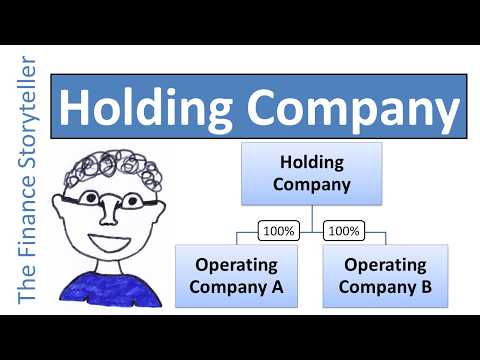
How does a holding company work? ⏱️TIMESTAMPS⏱️ 00:00 Holding company definition 00:59 Holding company example 01:25 Holding company benefits 03:38 Mixed holding company 04:09 Intermediate holding company 04:26 Real world example 05:08 Holding structure financial reporting Here’s the simplest holding company structure that I can think of: a holding company that owns 100% of the shares in an operating company. The holding company is the parent, the operating company is the daughter or subsidiary. A common definition of a holding company is: a company whose primary business is holding an interest in the securities of other companies. Most often a controlling interest. The operating company is a business entity that conducts day-to-day operations. The holding company hopes to benefit from the profits generated by one or more of those subsidiary operating companies! From that simple holding company structure we can start to build a more elaborate holding company structure. How about a holding company with two operating companies below it. Independent legal entities as part of a group. For example, operating company A is a car dealership, and operating company B owns the building that company A is located in. The car dealership pays rent to the real estate company. Why would you go through the trouble of setting up and maintaining this holding company structure, rather than running it all from just one company? Risk management is a BIG reason. In case something serious happens in either operating company A or operating company B, litigation or bankruptcy for example, you will most likely be able to isolate the problem in just that operating company, without it affecting the other operating company or the holding company. And in case the operating companies have been generating profits over time, you can decide either to leave those cumulative profits in the operating companies, or bring them up to the holding company through an intercompany dividend. Shareholders can then decide to keep these in the holding company, or distribute them as a dividend to the owners. If fortunes turn afterwards, then at least you have preserved the retained earnings by transferring them to the holding company. The second BIG reason is optionality, which comes in many forms. Want to expand into the bicycle business? Just add another operating company below the same holding company, either as a wholly owned subsidiary or a joint venture. Want to sell the car dealership and retire? Sell that operating company, but keep the real estate company for a rental income stream. Need financing to grow? Get a loan at the #holdingcompany level, and invest that money into the operating companies. Or get a loan in an operating company, with just the assets in that company as collateral for the loan. Tax efficiency. Example one. Depending on the country, if the holding owns a very substantial majority interest (at least 80% or in some cases even 95% of a subsidiary), they can file a joint tax return, allowing profits of one company to be offset by losses of another. Example two: tax-free reinvestment. Profits can be moved from operating companies to the #holding company without immediate taxation, allowing for reinvestment, acquisition, or debt repayment. Let’s look at some variations on holding company structures. What is a “mixed” holding company? This is where the parent company is both a holding company as well as an operating company. A “mixed” holding company is a corporate structure that both owns (controlling) interests in other companies and simultaneously conducts its own active business operations. A holding company that only owns interests in other companies would be called a “pure” holding company. What is an “intermediate” holding company? This is where the daughter has her own daughter, and therefore also becomes a parent. The top level holding company is called the ultimate holding company, operating company B is an intermediate holding company. If you are looking at financial reports in a holding company structure, it is very important to ask yourself which financial reports you are looking at! The consolidated (or “group”) financial statements? The whole family. Or just the company-only (“parent” company) financial statements? BIG difference! Philip de Vroe (The Finance Storyteller) aims to make accounting, finance and investing enjoyable and easier to understand. Learn the business and accounting vocabulary to join the conversation with your CEO at your company. Understand how financial statements work in order to make better investing decisions. Philip delivers #financetraining in various formats: YouTube videos, livestreams, classroom sessions, and webinars. Connect with me through Linked In! Want to get access to bonus content, and/or express your gratitude by buying me a cup of tea? Join my channel as a member through https://www.youtube.com/channel/UCQQJnyU8fALcOqqpyyIN4sg/join

Continue this lesson in the app
Install CourseHive on Android or iOS to keep learning while you move.




