Summary
Keywords
Full Transcript
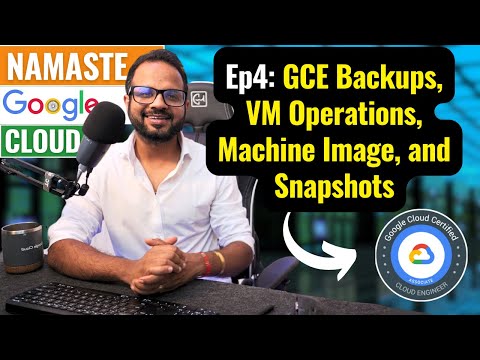
Hello Everyone, In this video, I will show you how to perform operations on a GCE VM, such as start/stop/delete/edit, and how to take disk snapshots and machine images and use those to provision a new VM for disaster recovery and troubleshooting purposes. This is the fourth video in the series “Namaste Google Cloud” where I will be publishing GCP videos every week. I have designed the playlist keeping in the mind beginners to advance levels so, if you have never worked with GCP before, don't worry, I have got you covered. This series will also cover the course content and sample questions of the Google Cloud Associate Cloud Engineer certification exam. This will be an ongoing series! 🔥Below topics are covered in this video: - How to perform basic operations on GCE VMs such as start/stop/edit/delete - Static IP vs Ephemeral IP - How to edit an existing GCE VM configuration - How to create a machine image from an existing GCE VM - How to create a VM from Machine Image - How to create a disk snapshot from an existing disk - Difference between Machine Image and Disk Snapshot - How to Schedule a Disk Snapshot in GCP - Knowledge Checks In this video, I will explain different GCP entities such as organizations, Projects, and Folders and, how they fit together in the GCP resource hierarchy. Please watch the complete video as we will be doing some knowledge checks at the end with some sample exam questions if you are planning for Associate Cloud Engineer Certification. 🔥 Check out our GCP playlist Namaste Google Cloud - GCP Tutorial for beginners https://www.youtube.com/playlist?list=PLl4APkPHzsUXvkDFARdrH2LMESVqeuH8W 🔥Below is the playlist for "Jenkins Tutorial for Beginners": https://www.youtube.com/watch?v=oUdB2XqtGmk&list=PLl4APkPHzsUV3pz6zRpFJe3A4wTM2Pjvv 🔥 Check out our complete AWS Playlists here: https://www.youtube.com/playlist?list=PLl4APkPHzsUUYlYFk5bgOU0Xhq_9c-9pQ https://www.youtube.com/playlist?list=PLl4APkPHzsUWjAfpYWQXQSQMcBi5rRFT7 https://www.youtube.com/playlist?list=PLl4APkPHzsUUmv8H5tdyYOCRUJhwbAbwX https://www.youtube.com/playlist?list=PLl4APkPHzsUVz9WMOx8GQTFsJV1Oi3dY6 https://www.youtube.com/playlist?list=PLl4APkPHzsUXIRGMYNgJ_tWHKb1kX0smQ Check out our Azure Playlists here: https://www.youtube.com/playlist?list=PLl4APkPHzsUWD2SGwampHqe0xqK0PuBZ2 https://www.youtube.com/playlist?list=PLl4APkPHzsUUd4rzzHEpHMsyD5PbVWz1I 🔥Check out our DevOps Playlist here: https://www.youtube.com/playlist?list=PLl4APkPHzsUX2loJZOo3XtITGtc9UQabd Subscribe to our channel to get notified about the latest videos. 🔥 https://www.youtube.com/TechTutorialswithPiyush Connect with me 👋 LINKEDIN: ► https://www.linkedin.com/in/piyush-sachdeva/ TWITTER: ► https://twitter.com/techie_piyush Join our learning communities 👋 https://www.facebook.com/groups/1015771332531944 https://www.linkedin.com/groups/12561913/ References 📚: https://cloud.google.com/compute/docs/disks/snapshots https://cloud.google.com/compute/docs/disks/scheduled-snapshots https://cloud.google.com/compute/docs/machine-images/create-instance-from-machine-image https://cloud.google.com/compute/docs/machine-images/create-machine-images https://cloud.google.com/compute/docs/instances/instance-life-cycle https://cloud.google.com/compute/docs/ip-addresses/reserve-static-external-ip-address

Continue this lesson in the app
Install CourseHive on Android or iOS to keep learning while you move.