Summary
Full Transcript
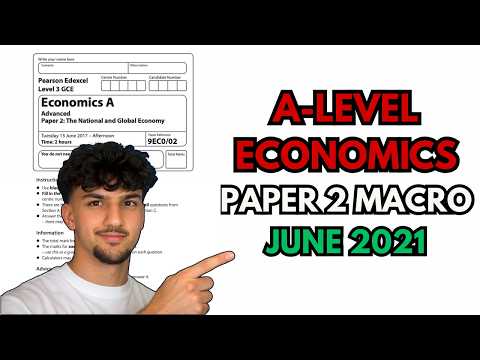
Exam Technique Tutoring : https://forms.gle/owj1pwyGHyqTSjFZ9 Economics Group Chat : https://beacons.ai/udoecon About this video : This video is a full exam technique + walkthrough for the Edexcel A Level Economics Paper 2 (Macro) 2021 exam, where we go through the entire paper step-by-step and break down how to approach each question, apply the extracts and data effectively, and build clear chains of analysis and evaluation. The focus is on helping you structure high-scoring answers across calculations, short responses, and extended essays. The aim of the video is to show how to approach the full paper under exam conditions, consistently applying macroeconomic theory to the context, while developing strong evaluation and clear judgement throughout. Questions in the video : Section A 1(a) Which one of the following is a withdrawal from the circular flow of income? (1) 1(b) Calculate the total final increase in US aggregate demand as a result of the President’s ‘expansionary fiscal policies’, assuming no other changes. (2) 1(c) Explain the impact of annual fiscal deficits on the US national debt. (2) 2(a) Which one of the following diagrams illustrates the impact of an increase in net exports along a Keynesian long-run aggregate supply curve? (1) 2(b) Using the classical long-run aggregate supply curve, explain what will happen in the long run to real output if aggregate demand increases. (2) 2(c) Explain the likely impact on aggregate demand of a fall in average house prices. (2) 3(a) Which one of the following has been the overall change in the British pound to US dollar exchange rate from 1st January 2018 to 1st January 2019? (1) 3(b) Explain the likely impact of the change in the exchange rate on the UK current account of the balance of payments. (4) 4(a) Explain one likely impact of the High Speed 2 project on aggregate supply in the UK. (4) 4(b) Government spending on the High Speed 2 rail link is an example of which of the following? (1) 5(a) From the data in the graph, which one of the following may be deduced? (1) 5(b) Calculate the percentage change in Germany’s nominal GDP from 2016 to 2017. (2) 5(c) Explain one reason why Purchasing Power Parities are used. (2) Section B 6(a) Calculate the change in the level of total aid funding to Rwanda between 2011 and 2012. (5) 6(b) Examine two likely benefits for the Rwandan economy of the growth in the country’s population. (8) 6(c) Assess the likely impact on the Rwandan economy of the change in aid received between 2017 and 2018. (10) 6(d) Discuss the likely impact on Rwandan consumers and clothing manufacturers of the increase in the tariff on imports of second-hand clothes. (12) 6(e) Discuss policies, other than import tariffs, that the Rwandan government could use to develop its manufacturing industries. (15) Section C 7. Evaluate the effectiveness of quantitative easing during a significant recession. (25) OR 8. Evaluate the potential trade-offs between environmental protection and other macroeconomic objectives. (25) Timestamps: 00:00 - Section A 18:09 - Section B 01:20:14 - Section C Topics covered: Circular flow of income, fiscal policy and multiplier, national debt, AD/AS analysis, exchange rates, balance of payments, aggregate supply, infrastructure investment, GDP and PPP, economic growth and development, aid, tariffs and protectionism, labour markets, macroeconomic policy, quantitative easing, environmental economics, evaluation and exam technique

Continue this lesson in the app
Install CourseHive on Android or iOS to keep learning while you move.