
Summary
Keywords
Full Transcript
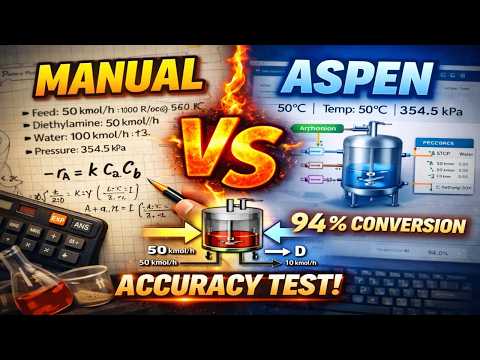
CSTR Manual vs Aspen Plus Simulation | Chemical Reactor Design In this detailed tutorial, we walk through manual CSTR design calculations, then perform the same analysis in Aspen Plus to validate and compare results. Whether you're a chemical engineering student or a process simulation beginner, this video will help you understand the theory behind CSTR sizing, kinetics, and how software like Aspen Plus solves engineering problems. 👉 Chapters: 0:00 — Introduction 0:41 — Problem Statement 2:01 — Parameters 2:46 — Manual Calculations 6:57 — Aspen Simulation 13:31 — Results Comparison 13:59 — Manual vs Aspen 14:41 — Final Remarks In this case, we simulate a liquid-phase CSTR to achieve ~94% ethanol conversion using reaction kinetics and residence time calculations. Later, we replicate the same conditions in Aspen Plus and compare results side-by-side. 📘 What you’ll learn: ✔ Step-by-step manual CSTR calculation ✔ Aspen Plus setup and parameter input ✔ Reactor sizing using kinetics and mass balances ✔ Interpretation of results from both methods ✔ Tips for validating manual calculations with simulation If you find this useful, like 👍, comment your questions below, and subscribe for more chemical engineering tutorials! #CSTR #AspenPlus #processsimulation #chemicalengineering #ReactionEngineering #processengineering

Continue this lesson in the app
Install CourseHive on Android or iOS to keep learning while you move.

