Summary
Full Transcript
Castiglianos theorem is a strain energy-based method with which we can easily calculate deflections. This is helpful for finding reactions of indeterminate structures, which you already know is when a static analysis is not enough to finding all forces and therefore all stresses, and check to statically indeterminate 10-minute video linked below if you need a refresher. 2. Making sure that the structure or system we're designing will still work under a deformed configuration, which will be specially important for cyclic loading, and 3.
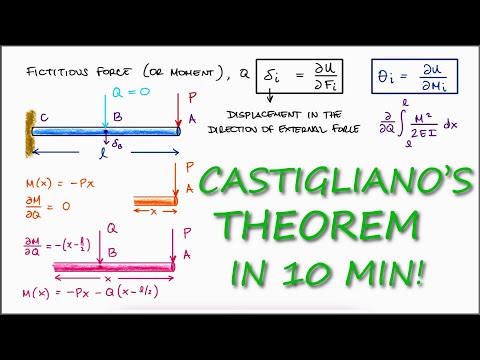
As I mentioned in the design factors and uncertainty 7-minute video linked below, to find the actual dimensions or positioning of elements during operation, meaning in a deformed state. This in turn is of utmost importance for calculating the initial design factor explained in that video. Following a basic work slash energy definition from physics, Castiglianos theorem states that the displacement caused by an external force in the direction of that force is equal to the partial derivative of the total strain energy with respect to that force. With the mechanical work being defined as the product of an external force times a displacement for a small element within an elastically deformed system that has been displaced by that external load, the energy would be equal to the force that acts on it times the displacement.
Because of this assumption, the Castiglianos theorem expression will only work for elastic system subjected to small displacements. Theorem is also defined for calculating rotational displacement. For example, in the displacement of a point somewhere along a deflected beam, you see that the displacement at that location can be calculated as an arc that has a length equal to R times theta. Since the force times the distance R is equal to the moment caused by that force, an infinitesimal energy du equal to df times delta can be worked with by substituting delta by R theta and R df by a dm to find an expression for the angle of deformation theta equal to partial of u with respect to m, of course in the direction of the moment m.
Of course, for these expressions to be useful, we need to understand how to obtain the strain energy from the different types of stress and strain. If we look at the external work done on an elastic member where the force deflection relationship is linear, think of a spring, for example. The force begins at zero when the elastic member is not deflected and f when it's deflected a delta amount. Therefore, this potential energy is the product of the average force during deflection f over 2 times that delta displacement.
Notice that the area under the curve is the same. Let's take a look at the different types of stresses we have already studied. For axial loading, the deflection is equal to fl over AE and therefore by substituting in the potential energy expression, the strain energy is f squared times l over 2 AE. However, if the external force is not a constant but a function of x, the axis of the member we're analyzing, we can write the energy as an infinitesimal du that is equal to that force still as a function of x over 2 times an infinitesimal delta.
Where d delta would be f times dx over AE. Therefore, the total energy would be the integral of this expression. The process would be almost identical for the erect shear where we use the variable capital V as the force to indicate that it's a shear force. Of course, in this case, the elastic modulus E would also be replaced by the shear modulus or the modulus of rigidity G as shear forces are related to shear strains by the force of the shear force.
If we use the expression for angle of twist that we derived in another video, link below to that 6-minute video and carry out the same process we did using the axial loading deformation expression, we would find the expression for the strain energy of torsion. If we look at pure bending and more specifically a tiny element subjected to bending, we can still use the original expression for strain energy. We can replace the infinitesimal arc ds by our d theta, just like we did a few moments ago, and this is possible because for a small deflection, d delta and ds are practically the same and then replace fr by the moment m. We then substitute d theta by ds over the radius of curvature rho and recalling what the radius of curvature yields from the pure bending 10-minute main video, linked below.
We substitute 1 over rho to find the strain energy expression for pure bending and again for small deflections ds is practically equal to dx. Finally, because we never studied the deflection due to transfer shear and because the math process is much more complex, rewrite the transfer shear expression as a variation of the direct shear expression where c is a correction factor whose values depend on the shape of the cross-section. For example, solid rectangular, solid circular, cylindrical, or hollow and thin rectangular sections. Let's take a look at one of the simplest examples for using castigliano's theorem where a circular cantilever beam is subjected to a downward load p.
If we wanted to know the deflection at point a, we could use the singularity functions we studied in another 10-minute video, linked below, integrate 4 times and use this structure's boundary conditions to find that deflection. Of course, that method would be easy for this simple example, but it would also not include the deflection due to the transverse shear. For more complex structures, that process would be several times longer than using castigliano's theorem. And that's the real issue, because for longer structures like this, the transfer shear component doesn't really contribute much to the overall deflection of a.
The real problem is that for more complicated structures, the singularity functions or integration methods would either result in much more time consuming calculations or it would simply just not work. Using castigliano's theorem, we see that to find the deflection of a, we will have to use the total strain energy, which in this case is caused by the bending and the transverse shear. The C correction coefficient that I just mentioned would be 1.11 for a circular beam. We know that the deflection of a is therefore the partial derivative of the integrals with respect to the force, which is the same as the integral of the partial derivative.
Since the shear force v in the transverse shear energy term is the external load p, the second integral requires us to derive p squared, which results in 2p. The chain rule for the first integral would yield at 2m times partial of m with respect to p, and we see for both integrals that the two cancel out. Notice that the chain rule for the partial of p squared would yield a dp dp, and that's why we didn't write it in the first place. However, for the moment it will be important.
To be able to calculate that first integral, we need m and the partial of m, meaning that we need the moment m as a function of x, which can be found by looking at a cut at any distance x from a. The moment m of x will be a negative 1 equal to p times x, and the partial with respect to p minus x. Substituting m and partial m partial p rearranging, integrating, and evaluating the integral, we can substitute the given values to see that the deflection of a is equal to 65.2 thousands of an inch because of pure bending and less than 3.10 thousands of an inch because of transverse shear. This shows us that the transverse shear accounts for approximately 0.4% of the total deflection, and is therefore like I mentioned before, almost always negligible for long structures.
With this simple example, we see that we can use castically anosteorem to calculate the deflection in the direction of a force for any point along the structure and due to any and every type of strain energy. But what if there's not an external force located exactly at the point where we want to calculate its deflection? In this case, we make use of a fictitious force Q, which is represented by a vector force Q of magnitude 0. Let's say we want to calculate the deflection at point p halfway between the fixed end at c and the free end at a of this cantilever beam, subjected to a load p at the free end.
Since the only load p is located at a and not b, we would have to add a fictitious force Q applied at b in the direction of the deflection that we want to calculate to be able to use castically anosteorem. Knowing that the transverse shear energy will not contribute much to the total deflection of the beam, the only energy term we should probably use here is that due to bending. To calculate the deflection at b, which is where Q is located, we would take the partial derivative of that energy with respect to Q, not p. And just like we did before, we can rewrite the partial derivative of the integral as the integral of the partial derivative.
This simplified expression for calculating the deflection due to bending, which is the chain rule that we did before, would always be the same. By the way, you can do this simplification for axial loading, torsion, transverse and direct shear too. In this case, the moment function m will be a piecewise function, which means that it's defined by more than a single equation, depending on the domain or what is the same, the input values of x. Starting at the load p, if x is between 0 and half of the length of the beam, l over 2, a simple free body diagram of the cut would show us that the moment that x would be equal to minus p times x.
On the other hand, if x is between l over 2 and l, the free body diagram of that cut would show us that both Q and p affect the moment function m of x. This means that the integral needs to be split into 2, 1 from 0 to l over 2 and 1 from l over 2 to l. Now, since we need the partial derivatives for each section 2, we calculate the partial derivative of the moment with respect to Q for each one of the two sections of the beam, and we substitute both m and the partials of each section within the integral. Since the partial of m with respect to Q is 0 for values of x between 0 and l over 2, the first integral is 0, and since the magnitude of Q is 0, the second integral is greatly simplified.
Integrating the remaining terms, evaluating them between their interval, and simplifying the fractions we obtain, we find that the deflection is 5 over 48 times p l cubed over e i. If you want to check other 2-minute long Castigliano's Theorem examples, including one where we use the strain energy of torsion, and another one where we solve the pure bending problem that we had solved using singularity functions, now using Castigliano's Theorem, make sure to check out the links in the description below. Down in the description, you will also find the links to the other 10-minute videos of the Mech Design Slash Machine Design course, as well as the playlist to other mechanical engineering courses such as statics and mechanics of materials, if you need a refresher on any of those topics. So make sure to check those out too.
Thanks for watching!

Continue this lesson in the app
Install CourseHive on Android or iOS to keep learning while you move.