
Summary
Keywords
Full Transcript
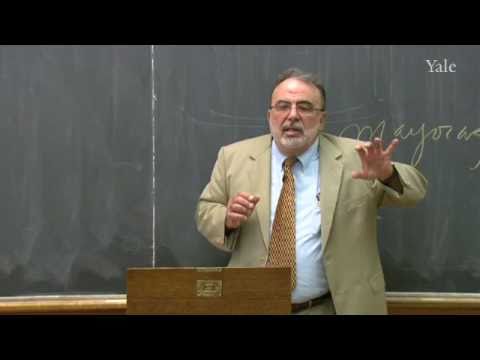
Cervantes' Don Quixote (SPAN 300) González Echevarría starts out by commenting on what he calls the two overarching plots of the Quixote: the story about the writing of the novel, and the story about the mad hidalgo. The first is based upon several levels of narratives that distance Cervantes from his own creation. He does so as the painter Diego Velázquez in Las Meninas which shows multiple incomplete perspectives of the same work, portrays the work behind the scenes of creation, it includes the viewer in the painting as well as the author, as another character, not in a central position, but in an oblique one. With their techniques, both Cervantes and Velázquez present the limitations of human knowledge. The madness of Don Quijote is present in the two episodes that González Echevarría comments upon afterward. The episode with the goatherds connects the ideal world (inside the hidalgo's mind) and the real world of the goatherds. Their human kindness becomes a human quality in the novel displayed by many regardless of social origin. The story of Marcela and Grisóstomo follows. Here Cervantes portrays their socio-economic world while at the same time he defends their free will above everything else. 00:00 - Chapter 1. Exaggerated Mimicry, Virtual Texts and Ironic Distancing 09:41 - Chapter 2. Cervantes and Velázquez: Self-Reflection and the Limits of Knowledge 31:19 - Chapter 3. Introduction to The Holy Brotherhood; The Goatherds and Human Kindness 41:34 - Chapter 4. Marcela and Grisóstomo, Social Position and Free Will Complete course materials are available at the Open Yale Courses website: http://open.yale.edu/courses This course was recorded in Fall 2009.

Continue this lesson in the app
Install CourseHive on Android or iOS to keep learning while you move.


