
Summary
Keywords
Full Transcript
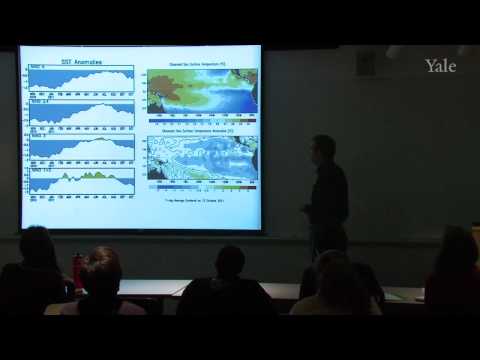
The Atmosphere, the Ocean and Environmental Change (GG 140) The El Niño/Southern Oscillation (ENSO) phenomenon is the primary mode of variability in the equatorial Pacific Ocean. It is composed of two extreme states, El Niño and La Niña. The oscillation between these states can be seen in measurements of sea surface temperature (SST), sea level pressure, thermocline depth, and easterly trade wind strength. Changes in SST and pressure lead to shifting of convective activity across the equatorial Pacific. Changes in the strength of the easterly trade winds lead to changes in the depth of the thermocline, which affect coastal upwelling offshore of South America. If upwelling is reduced, primary productivity is also reduced. The effect of ENSO on atmospheric convection and coastal upwelling makes it an important factor for both agriculture and fishing industries. 00:00 - Chapter 1. El Niño and La Niña 10:08 - Chapter 2. Terminology 11:33 - Chapter 3. Symptoms of El Niño 18:54 - Chapter 4. ENSO Indices and Ocean Water Property 24:40 - Chapter 5. Current ENSO Data 39:45 - Chapter 6. Ice in the Climate System 42:39 - Chapter 7. Physical Properties of Ice Complete course materials are available at the Open Yale Courses website: http://oyc.yale.edu This course was recorded in Fall 2011.

Continue this lesson in the app
Install CourseHive on Android or iOS to keep learning while you move.

