
Summary
Keywords
Full Transcript
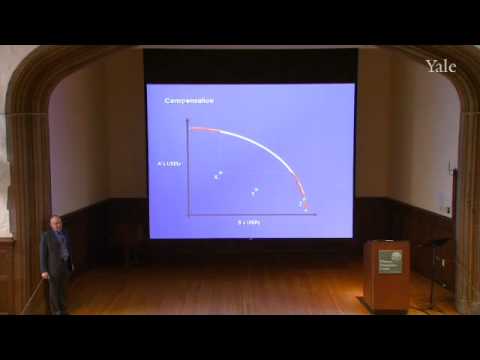
Moral Foundations of Politics (PLSC 118) Today, Professor Shapiro dives more deeply into Robert Nozick's theory of the minimal, or night watchman, state. This formulation is not redistributive, nor does it consider rights as goals, but rather as side-constraints on what we can do. In other words, Nozick's is a deontological, not teleological, approach. However, the Achilles' heel of this formulation is the incorporation of independents, based on a system of compensation. Some people will opt not to enter into our hypothetical social contract, but for the dominant protective association to protect its members from the fear of these independents, they must be forced to incorporate. Nozick thinks that if members could compensate the independents for this rights violation, it would legitimize the state. Unfortunately, no one has ever solved the puzzle of compensation without some interpersonal comparison of utility. But another way to salvage Nozick's account is with the Kantian dictum "ought entails can," meaning that since independents cannot be tolerated, it cannot be an obligation not to violate their rights. But what if the independents could compensate the members for their fear? And couldn't this compensation model be used to justify the welfare state as well? Isn't the value of consent, in which Nozick's account is rooted, completely violated here? 00:00 - Chapter 1. Evolution of the State without Rights Violations 15:50 - Chapter 2. Nozick's Theory of the Only Legitimate State 20:57 - Chapter 3. A Compensation Test That Is Compatible with the Pareto System 23:17 - Chapter 4. Neoclassical Utilitarianism: The Pareto Diagram Complete course materials are available at the Open Yale Courses website: http://open.yale.edu/courses This course was recorded in Spring 2010.

Continue this lesson in the app
Install CourseHive on Android or iOS to keep learning while you move.


