
Summary
Keywords
Full Transcript
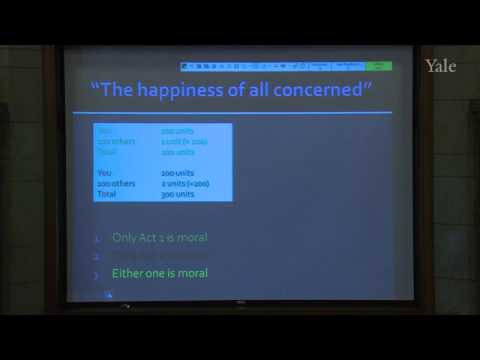
Philosophy and the Science of Human Nature (PHIL 181) Professor Gendler begins with a general introduction to moral theories--what are they and what questions do they answer? Three different moral theories are briefly sketched: virtue theories, deontological theories, and consequentialist theories. Professor Gendler introduces at greater length a particular form of consequentialism—utilitarianism—put forward by John Stuart Mill. A dilemma is posed which appears to challenge Mill's Greatest Happiness Principle: is it morally right for many to live happily at the cost of one person's suffering? This dilemma is illustrated via a short story by Ursula Le Guin, and parallels are drawn between the story and various contemporary scenarios. 00:00 - Chapter 1. What Is a Moral Theory? 15:37 - Chapter 2. Introducing Utilitarianism 37:34 - Chapter 3. The Omelas Story Complete course materials are available at the Open Yale Courses website: http://oyc.yale.edu This course was recorded in Spring 2011.

Continue this lesson in the app
Install CourseHive on Android or iOS to keep learning while you move.




